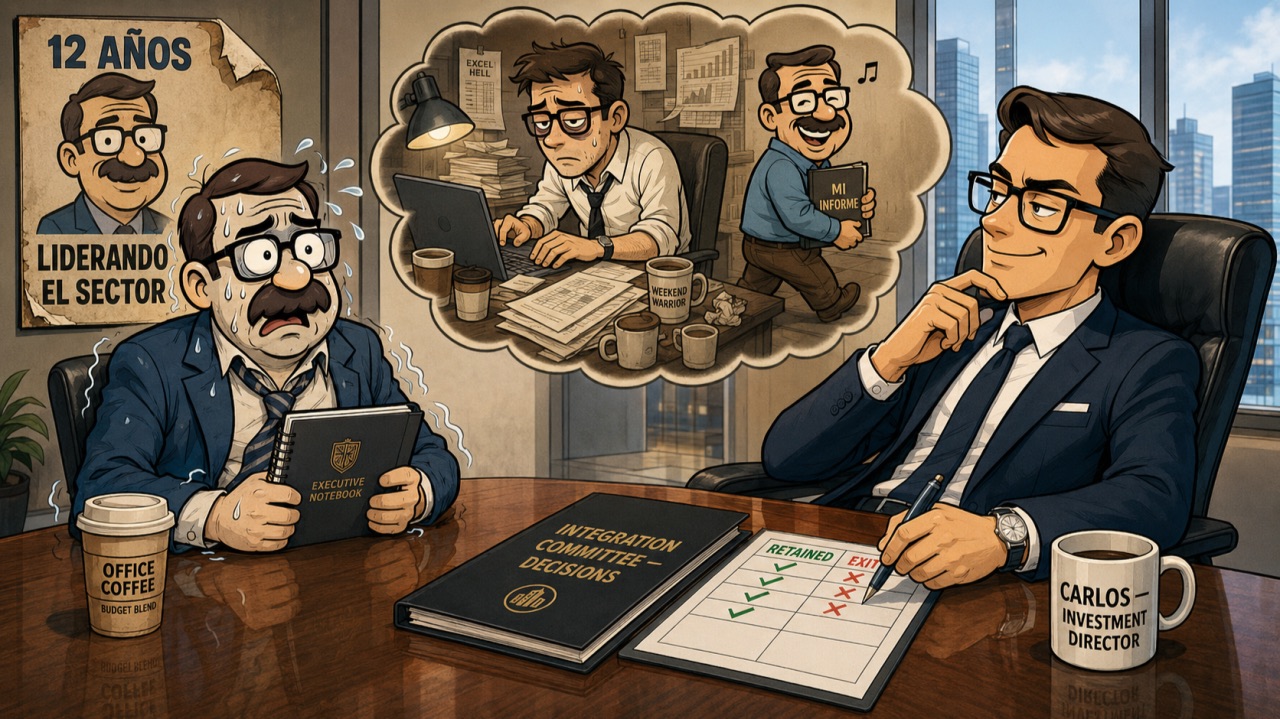
Thursday. 10:50. Manolo walks in as if someone had put weights in his shoes. The face of a man who has seen a ghost.
—Jose, we need to talk.
—Manolo, what's wrong?
—Do you remember the intern we had twelve years ago? Carlos. The one who didn't fit in.
—The one who didn't fit in according to you. The rest of the team adored him.
—Well, that's debatable.
—It isn't. Go on.
—The fund that bought the company. The executive coming tomorrow to decide who stays and who doesn't. It's him. It's Carlos.
Silence.
A long one.
—The Carlos you told "this kid will never amount to anything because he lacks hunger"?
—That one.
—The one who asked you for strategy training and you answered "you stick to your job, leave the thinking to the grown-ups"?
—That one.
—The one you fired during his probation period with a three-line email, after he'd spent two weekends pulling together a report that you signed as your own?
—That one.
—Manolo, this is the most beautiful thing you've told me in five years.
—Jose, you're not helping.
—How did you find out?
—This morning. The committee dossier. Photo and name. Carlos Méndez. Investment Director. I clicked on the photo and there he was. Twelve years older. And tomorrow he decides whether he keeps me.
Silence. Manolo closes his eyes. For the first time in twelve years, I see him genuinely scared.
—Jose, what do I do?
—Manolo, before I answer, let me enjoy the moment for thirty seconds.
—Please.
—You have an intern you despised. Who left. Who in twelve years has built a career you will never build. And who has come back into your life in the exact position where he can repay every humiliation with a signature. From "Retained" to "Exit". That's not revenge, Manolo. That's statistics. That's what happens when you treat people the way you've treated them. Twelve years later, those people come back. Sometimes as a customer. Sometimes as an investor. Sometimes as your boss.
—It's very improbable.
—No. It's frequent. What's improbable is you seeing it coming, because you never look at who you leave behind. You only look at who's coming up behind you.
—So what do I do?
—There's nothing you can do between now and tomorrow that changes the outcome. If Carlos is decent, he'll judge you by your work. But if Carlos remembers exactly how you treated him, and I guarantee you he remembers it in detail, you're not going to fool him tomorrow with a smile. Because the person he saw back then was the real one. And the one you fake tomorrow, he'll have seen coming too.
—I didn't treat him that badly.
—Manolo, you fired him by email after squeezing two weekends out of him. And YOU signed the report he wrote. Do you really think he's forgotten?
—I was young.
—Who? You or him?
Silence.
—Me.
—Bingo. When someone treats a person badly, they usually justify it by saying "well, the other guy was young and had to learn". The reality is that the one who had to learn was you. And you didn't. And that's why twelve years later you're still doing the same thing. The difference is that now the victim isn't an intern. It's a Manolo. And the intern is on the other side of the table.
—And what do I do tomorrow?
—One single thing. Don't fake it. Don't say "what a joy to see you". Don't slap him on the shoulder. Look him in the eye, shake his hand, and tell him the truth. "Carlos, I treated you badly twelve years ago. I know it. I expect nothing from you because of this. But I wanted to say it before we start talking business." That, said without an angle, is the only thing you have left.
—And if he says "too late"?
—Then it will be too late. But at least you'll die on your feet. If you show up as if nothing happened and start sucking up, Carlos will fire you with the same smile you fired him with. And that would be poetic justice in its crudest form.
Bob Sutton distills it in The No Asshole Rule:
> the real cost of mistreatment isn't paid the day it happens. It's paid years later, in places you never expected, in ways you never imagined.
And it's paid with compound interest. Because people who get humiliated don't forget.
—And what if it hadn't been Carlos? What if it were someone else?
—Manolo, that's the right question. It doesn't matter that it's Carlos. What matters is that somewhere in your career there are ten Carloses waiting for the elevator to come back down. You just got this one. But there are more. There always are.
He gets up. More slowly than when he came in.
—I'm going to think about what to say to him.
—Don't think too much. The only thing you need to tell him is already in your head. It's just a question of whether you have the courage to say it with your mask off.
He leaves.
And I'm left thinking about one thing. That somewhere in the office, right now, there are three interns working. And Manolo doesn't remember any of their names. Twelve years from now, two of them will be nobody. But one will be somebody. And that one, Manolo, will one day decide something important about your life.
And you won't see it coming.
Because for Manolo, interns aren't people. They're paperwork. And paperwork has one nasty habit: it comes back. With interest.
Take care of the people you're not obligated to take care of.
Thanks for reading.
We all know a Manolo. Sometimes we are the Manolo. A new one every Tuesday. Subscribe so you don't miss it.