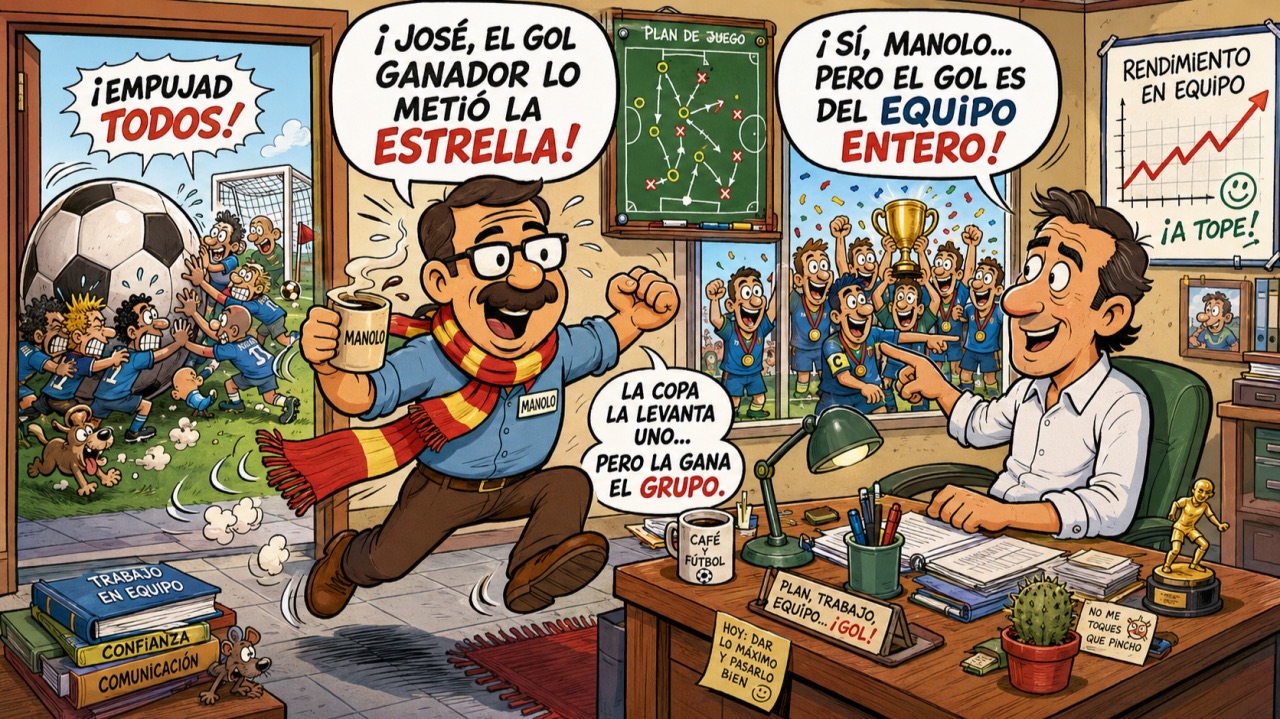
Monday. 9:00. Manolo walks in still wearing his Spain scarf. Euphoric. Like half of Spain after last night.
—Jose! World champions! Did you see Ferran's goal in extra time?
—Unbelievable, Manolo. Huge.
—What a player. Hey, and you know what he said afterwards? That the goal wasn't his. That it belonged "to 47 million people". After getting criticized the entire World Cup, he scores the goal that wins the cup, and he says it's not his. Weird thing to say, no?
—Weird?
—Come on, if I score that goal, I'm getting carried out on shoulders and making sure the whole world knows it. I'm not giving it away.
And there it is. The sentence that explains, in one line, why Manolo runs a team and not a world champion team.
—Manolo, sit down. Because what struck you as weird is exactly what separates the teams that win from the teams that merely play.
Manolo sits down, without taking off the scarf.
—Ferran spent an entire World Cup being criticized. That he was dead weight, that he wasn't scoring. And in the final he scores the goal that gives Spain the second cup in its history. The biggest moment of his career. And instead of saying "me, me, me", he says the goal belongs to everyone.
—Sure, but that's marketing. It plays well.
—It's not marketing, Manolo. It's understanding how winning works. That goal doesn't exist without the forty plays that never make the replay. Without the guy who assisted. Without the center-back who held the 0-0 for 106 minutes. Without the goalkeeper who didn't concede all tournament. Ferran scored the goal. But everyone built it. And he knows it. That's why he gives it away. Because he knows it was never his to keep.
—Fine, but somebody puts it in. And it was him.
—Of course. Just like in your company somebody signs the project, somebody presents to the committee. And that somebody is almost always you. The difference is what you do in that moment. Ferran, in his moment of glory, pointed at the team. You, in yours, point at the mirror.
—That's not true.
—Manolo, the big client project, the one that went perfectly. What did you say in the committee?
Pause.
—That it had been a great piece of work.
—You said "I managed to pull this off". I. Me. And that project was carried by nine people over four months while you were in meetings about something else. You supplied the final touch, the presenting of it. And you claimed the entire goal. The other forty passes, you erased.
—Well, I was the one responsible.
—And Rodri was the captain. And he lifted the cup pointing at the people behind him. At the physio. At the fourth-choice keeper. Because captains who truly win know that the "I" that wins alone is an "I" that loses the following year, when the people holding him up stop doing it because he never once said thank you.
Jim Collins documented it in Good to Great, studying the best business leaders in the world. He called them Level 5 leaders, and they all shared the same reflex: when things went well, they looked out the window and credited their people; when things went badly, they looked in the mirror and took the blame. The mediocre ones did exactly the opposite. Success, mine; failure, the team's. You, Manolo, have spent twenty years looking out the window for culprits and into the mirror for credit. Backwards.
Long silence. Manolo, at last, takes off the scarf.
—So Ferran, saying the goal wasn't his…
—…gave the best leadership class you'll see all year. For free. In prime time. A twenty-three-year-old kid, criticized for a month, scores the goal of his life, and the first thing he does is give it away. He understood at twenty-three what you haven't understood at fifty: that goals are scored alone, but they're built as a team. And that whoever keeps the goal for himself, sooner or later, is left without a team.
—That one hurt.
—The truth hurts sometimes. But look at the bright side: last night Spain gave you, along with a cup, the best management manual there is. With a happy ending.
Manolo picks up the scarf. Gets up. Before leaving, he turns around.
—Jose. The big client project. The one I said I pulled off. Am I still in time to send the team an email giving them the credit?
—It's never too late to say thank you, Manolo. It has only one rule: it has to be real. Not to look good. But because you've understood that the goal was never yours.
—I think I've understood.
—Then you're still in time.
He leaves. With the world champion's scarf in his hand. And, for the first time in a long while, with something resembling a lesson learned.
And I'm left thinking that it took Spain winning a World Cup, and a kid giving away the goal of his life, for Manolo to understand what I've been telling him in this office for years.
Sometimes the lesson isn't in a management book.
It's in a twenty-three-year-old kid who, at the best moment of his career, looks into the camera and says the credit belongs to others.
Forty-seven million others. None of them him.
That, Manolo, is a champion. Everything else is keeping the scarf...
Thanks for reading.
We all know a Manolo. Sometimes we are the Manolo. A new one every Tuesday. Subscribe so you don't miss it.