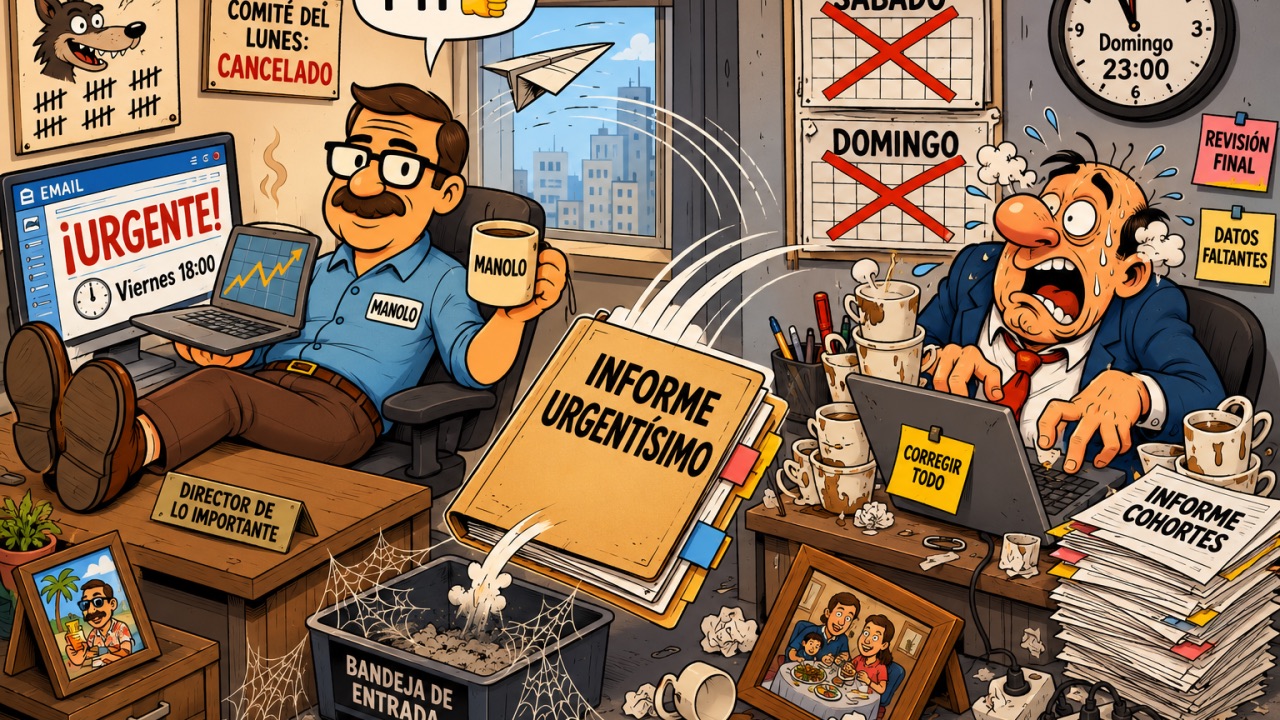
Monday. 9:00. Manolo walks in calm. Too calm for what he did on Friday.
—Manolo, remember the report you asked David for on Friday at six?
—What report?
—The cohort analysis one. You needed it for Monday "without fail". "Urgent." "For the committee." David spent Saturday and half of Sunday on it. He canceled a family lunch. He sent it to you Sunday at eleven at night.
—How efficient of David.
—Have you read it?
—It's in my inbox. I'll look at it this week.
—The committee was today at nine. It's five past nine. And you haven't read it.
—Well, something more of a priority came up. I'll get to the report when I can.
And there it is. The sentence that sums up management's perfect crime: the urgency that was only urgent for the person who wasn't going to suffer it.
—Manolo, sit down. What you've just done is more serious than you think. And not because of the report.
—Why then?
—Because of what you've just taught David. And the whole team that knows what happened.
Manolo sits down.
—Let's do Friday's math. You, at six, said one word: "urgent". It cost you zero. You dropped it on your way out the door. That word cost David a weekend. A family lunch. Explaining to his partner why he was working on a Sunday again. You said one word. He paid two days of his life.
—But I believed I needed it.
—"Believed". That's the key. You didn't know it. You believed it. And when you're not sure but you ask for it urgently just in case, the one who absorbs the cost of your doubt isn't you. It's David. You cover your back for free. He pays your insurance premium with his weekend.
—It seemed important in the moment.
—Manolo, almost nothing that seems important on a Friday at six still seems important on a Monday at nine. Friday's last-minute urgency is, ninety percent of the time, your own anxiety dressed up as a company priority. You don't want to carry a worry through the weekend, so you convert it into an urgent email and dump it on David. You go home relaxed. He stays behind with your anxiety converted into his task.
—Well, David did it. He didn't complain.
—That's the big problem, not the small one. Do you know what David is thinking right now, while his report rots unopened in your inbox? Two things. One: "my time is worth nothing". Two, the one that will cost you dearly: "the next time Manolo says urgent, I won't believe him".
—So what?
—So you've spent your word "urgent". You've burned it. The day something is truly urgent —the system goes down, the big client is about to walk— and you tell David "it's urgent", he'll think "sure, like the report you never read". And he'll go at his own pace. And that time it mattered. And it will arrive late. Because you spent the word on a Friday whim.
It's the boy who cried wolf, Manolo. You shout "wolf!" so many times without a wolf that the day it actually comes, nobody runs. You've spent years shouting "urgent" without a wolf. And your team stopped running a long time ago. Only, since you don't read the reports, you don't even notice when they arrive late.
Long silence.
—So I can't ask for urgent things?
—Of course you can. But urgency is a currency. If you print too much of it, it devalues. Before saying "urgent", three questions. One: do I need it for a specific date, or am I just getting it off my plate? Two: will I use it the moment it arrives, or will it sit in my inbox? Three: is the cost I'm imposing on this person proportional to the value I'll get out of it? If all three answers aren't clear, it's not urgent. It's your anxiety. And your anxiety is not a company emergency.
—That makes me look undemanding.
—The opposite. A boss who only says "urgent" when it truly is has a word worth gold. When he says it, the team drops everything and runs, because they know it's real. That's the kind of demanding that works. Yours, crying wolf every Friday, isn't demanding. It's noise. And noise, over time, gets ignored.
—And what do I do about David?
—Two things. Today, now: you go and tell him the truth. "David, I asked you for that report as urgent and the committee went a different way. I haven't read it yet and I'm sorry I made you lose your weekend. Next time I'll calibrate better." No excuses. No "something came up". The responsibility is yours.
—And the second?
—Forever. The next time you're about to type "urgent" on a Friday at six, you stop. You breathe. And you ask yourself whether it really can't wait until Monday. Ninety percent of the time, it can. Because ninety percent of your urgencies never were. They were your inability to go home with an open task without dumping it on someone.
Manolo looks at his notebook. He hasn't written anything. For once, he just listens.
—You know what the worst part is, Jose?
—Tell me.
—That I didn't even remember asking him for it.
—That is exactly the size of the problem, Manolo. You didn't remember. David won't forget it for months. That asymmetry —what you forget and what gets engraved in them— is what determines whether a team follows you or merely puts up with you.
He gets up. Before leaving, he turns around.
—I'm going to talk to David.
—Good idea. And Manolo: read the report first. Even though the committee is over. Even though you don't need it. The very least you owe someone who gave up their weekend for something is that human eyes read it. Even if it's late. Even if it's only out of respect for the effort.
He leaves.
And I'm left thinking that "urgent" is the cheapest thing a boss can say and the most expensive thing a team can pay. And that almost every Manolo spends it as if it were infinite, without realizing that every time they waste it, they're left with a little less for the day they truly need it.
And that day always comes.
And on that day, the team, at last, doesn't run.
Because they were taught, Friday after Friday, that Manolo's wolf was never a wolf.
It was just Manolo, who didn't want to go home with a task left open.
Thanks for reading.
We all know a Manolo. Sometimes we are the Manolo. A new one every Tuesday. Subscribe so you don't miss it.