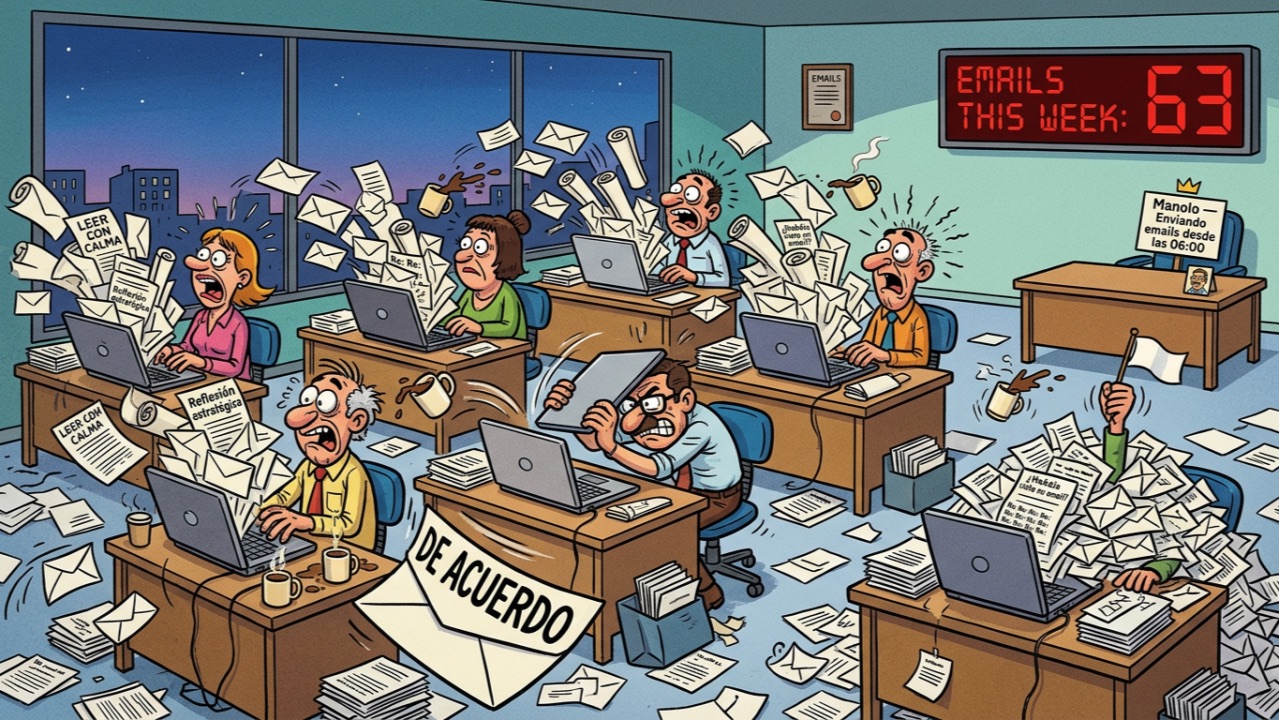
Monday. 07:12. My phone buzzes. Email from Manolo.
Subject: "Strategic reflection — READ CAREFULLY".
It's 847 words. With bullet points. With a chart pasted from Excel that looks pixelated. And a final sentence in bold that says "I remain at your disposal for comments."
Nobody asked for it. Nobody is going to read it. Nobody is going to comment. But Manolo has already done his work for the day. At seven in the morning. In his underwear.
At 09:00 he walks into my office.
—Did you see my email?
—Manolo, it was seven in the morning.
—Yes, I woke up with the idea and didn't want to lose it.
—That's what the Notes app on your phone is for.
—But I needed you all to see it.
—You needed us to KNOW you were awake at seven thinking about the company. Which is not the same thing.
Silence.
—Manolo, do you know how many emails you send a week?
—I don't know. Twenty?
—Sixty-three. I counted them. Sixty-three emails. Of which forty-two are replies to threads where nobody asked you, fourteen are documents nobody requested, and seven are "did you see my previous email?".
—It's just that people don't reply.
—Because they have nothing to reply to, Manolo. Not every thought deserves an email. Sometimes an idea can stay in your head, mature quietly, and die there in peace without bothering anyone. Like most ideas. Like most emails.
—But I add context.
—No. You add noise. And noise has a cost nobody measures: every email of yours interrupts someone who was doing something useful, forces them to open it because it says "READ CAREFULLY" in capital letters —which is the most effective way to guarantee nobody reads it carefully—, they discover it requires no action, and they go back to what they were doing having lost ten minutes and their focus.
Cal Newport calls it the "context-switching cost" in A World Without Email: every interruption takes an average of 23 minutes to recover from. Your 63 weekly emails are 63 interruptions. That's 24 hours of focus destroyed. Per week. Congratulations, Manolo: you're a weapon of mass productivity destruction with an automatic signature and a legal disclaimer.
—Jose, that's an exaggeration.
—An exaggeration? Manolo, your last email, copying eight people, was to say "sounds good". Two words. Eight notifications. Sixteen minutes of humanity lost forever to communicate that you agreed with something that had already been decided without you.
—I wanted it on the record.
—On the record where? At the Hague tribunal? Manolo, a "sounds good" copying eight people isn't communication. It's marking territory. It's the digital equivalent of a dog peeing on a lamppost: it adds nothing, but everyone knows you passed by.
—Jose, so I just don't send emails?
—Send the ones someone needs to receive. If the recipient doesn't need to do anything after reading it, don't send it. If it's only so they know you exist, don't send it. If it's an 847-word "strategic reflection" you wrote in your underwear at seven in the morning because you woke up inspired, do yourself a favor: write it in Notes, take a shower, have breakfast, and reread it at ten. If at ten it still seems like a good idea, send it. You'll see how 80% dies in the shower.
—But if I don't send emails, nobody knows what I'm working on.
—Manolo, if the only way to prove you work is to send emails, the problem isn't the email. It's the work.
Long silence.
—I'll think about it.
—Perfect. But if you send me an email with your reflections on the subject, I'm blocking you.
He leaves.
At 17:43 I get an email. Subject: "Re: Strategic reflection — UPDATE". It's 612 words. With a new chart. And a note that says "I've simplified the previous one."
Because Manolo doesn't communicate. Manolo broadcasts. Like an antenna. Nonstop. No filter. Never asking whether anyone on the other end wants to receive the signal.
Thanks for reading.
P.S.: Let me take the chance to recommend that you ban in your company, if you can, emailing AI-generated documents nobody has read. A one-paragraph summary forces the sender to read and understand it, and your health will thank you.