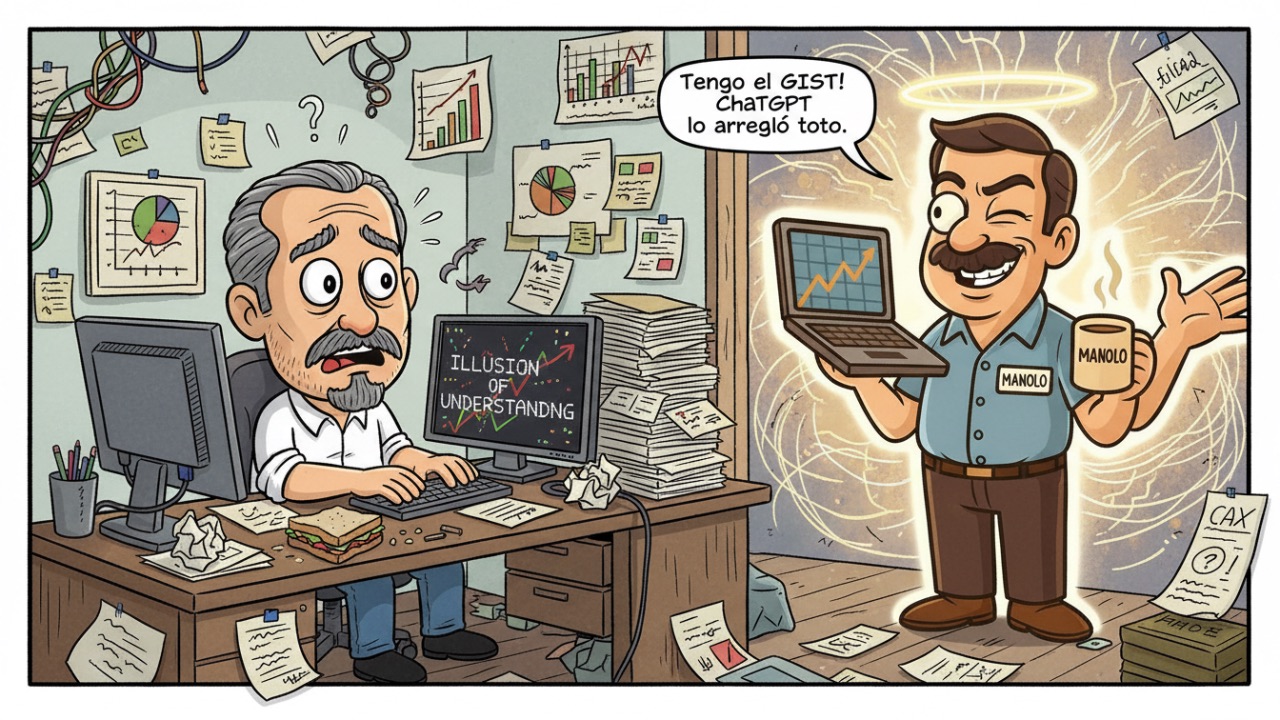
Tuesday. 09:12. My office door opens without a knock. Because Manolo doesn't knock. Manolo just appears, like a bout of shingles on your back: the day was going fine, and suddenly it's wrecked.
Coffee in hand, laptop under his arm, and that face of someone who has discovered something he thinks is going to surprise me yet again...
—Jose, I've been using ChatGPT this weekend. The latest version is the smartest one of all.
I swallow. Nothing good ever starts with that sentence. With version 5.1 he literally thinks he's Zarathustra.
—I've been reading about product strategy, organizational culture, outcome-based evaluation, team structures, decision-making... all crystal clear. Long live this AI thing. It works great for those of us what's smart.
There it is.
He thinks he's got the GIST.
The gist, that concept James Peters (FCIM) taught me years ago to lift my spirits, back when I told him I couldn't understand everything said in an English-language movie and he told me what mattered was the gist, that you didn't need to catch every word (which is true).
But applied to Manolo, the gist is... the summary without the marrow, the outline... without the bone.
The illusion of understanding.
I call it GIST management, and I'm coining the term right here, because if Andrej Karpathy gets to coin Vibe Coding, I can also... give it a try :)
It's like when someone says they "speak English" because they understand 70% of a YouTube video about a video game they've mastered... and then declares, with full conviction, in a meeting: "I am agree."
—And what have you understood, Manolo?
He sits down.
He crosses those sausage fingers of his, which, according to him, run in the family and have nothing to do with the 30 extra kilos he's carrying around. He smiles like a man about to change the history of management.
—The important thing is to iterate. If something doesn't work, we pivot. Speed. Action. Less theory. That's it.
It takes some serious nerve to look at someone who has spent 25 years learning where NOT to move a piece and tell him: "that's it."
I didn't invent this.
Donald Schön explains it, and more or less (my reading) it comes down to this:
> The great danger is confusing the ability to talk about a practice with the ability to practice it.
But of course, Schön isn't on TikTok.
Manolo doesn't understand product. Manolo doesn't understand business. Manolo doesn't understand culture.
What Manolo understands is ChatGPT summaries.
Because now everybody does summaries.
Summaries of books they haven't read...
Summaries of theories they've never applied...
Summaries of management frameworks they've never used in a real context...
Somebody should summarize them... down to their minimum expression...
Manolo doesn't want to learn. Manolo wants to feel like someone who already knows.
The big boss. The almighty ChatGPT deity.
And then begins the tour of actions he's going to execute, like a man going door to door selling encyclopedias...
First he drops by HR:
—Guys, we're going to evaluate by outcomes, not outputs —he tells them, with the confidence of a man who has read half a tweet by Marty Cagan.
The HR people look at him the way you'd watch someone trying to sacrifice a goat on the meeting-room table.
Then he drops by product:
—Guys, the important thing is to move fast. If a feature doesn't work, we change it. Forget the roadmap. "We is agile."
What he thinks he's doing: introducing agility. What he's actually doing: finishing off what was already broken.
Then he goes to the business folks:
—We need to focus on business value, not effort. Value shows up in the P&L!
That's not strategy. That's corporate homeopathy.
This is where I stop him.
—Manolo, tell me one thing: would you take a medicine prescribed by someone who "got the gist of medicine" watching videos?
He goes quiet.
And here's where Feynman comes in, not because he makes for a pretty quote, but because it's exactly this:
> "The first principle is that you must not fool yourself, and you are the easiest person to fool."
The gist is comfortable. The gist is fast. The gist is sexy.
But the gist doesn't hold up complex systems.
Like teams.
Like incentives.
Like culture.
Like a product that isn't a toy.
—So what do I do, Jose?
—What the real big shots do, Manolo...
> Understand enough to ask better questions. And genuinely trust the people who do understand the answers.
You don't need to know more than everyone else. You just need to not pretend you know when you don't.
Because the worst form of ignorance isn't the lack of knowledge. It's the feeling of knowledge.
And GIST management is ignorance with self-esteem and GPT steroids.
If tomorrow Manolo comes back to me saying:
—Jose, I've already read the summary of Donella Meadows' book "Thinking in Systems."
We'll know we've lost again...
Because bridges don't stand on "the general idea" they give you in first-year civil engineering physics. They stand on structural calculations.
Neither do companies.
And... people... even less so.
We live in difficult times. Proven professionals with years, even decades of experience are currently facing ChatGPT-powered GIST Management, which is turning a job they used to enjoy... into hell.
Everything passes... like vibe coding, where they're now hunting for experts to fix the crap that got built, some even raising funding rounds off it.
Today I'm only going to ask you for one thing. Have a conscience, and lean on real experts.
Thanks for reading.