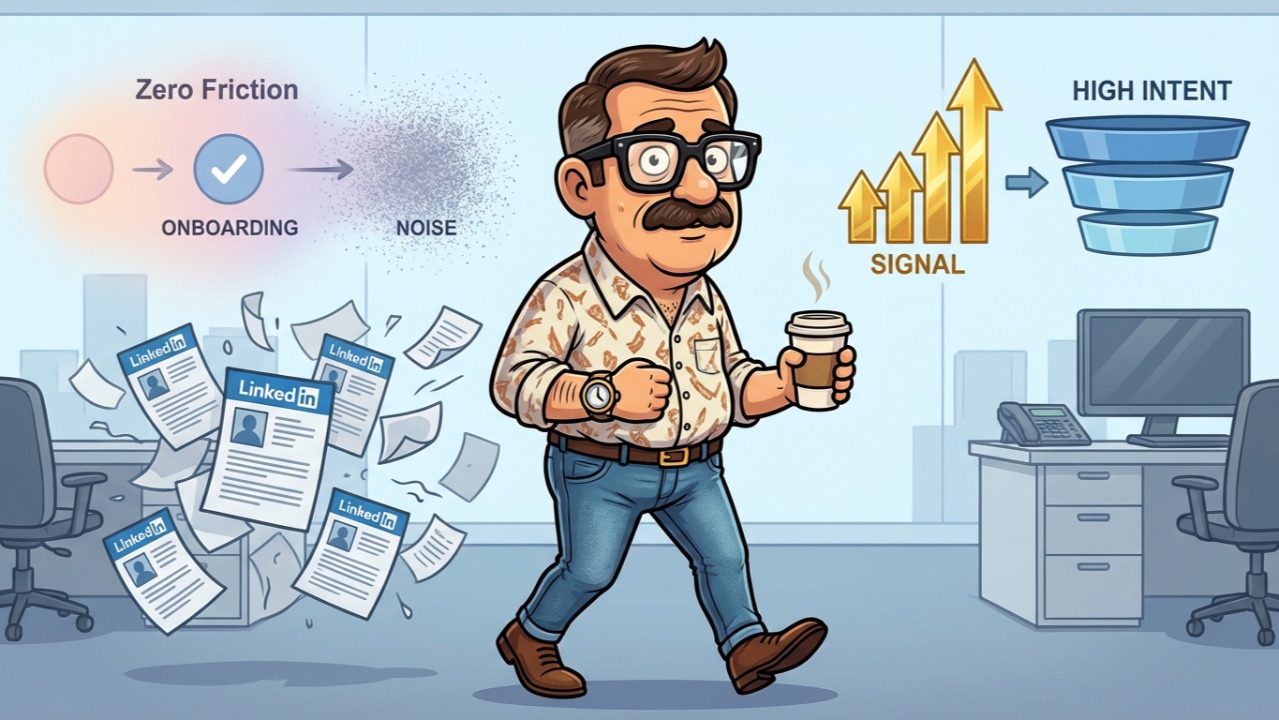
Today he comes in with the expression of a man who has seen the light in Figma. He's done a quick YouTube course, and all he's missing is the shaved head, the thick-rimmed glasses and the skinny jeans.
That freshly converted look of "this time it's really it".
—I've got it, Jose —. I designed a hell of an onboarding myself. Zero friction. The user is going to fall in love. And if the user falls in love, ready the rocket, because we're taking off.
I close my laptop the way you'd slam your notebook shut in secondary school when the recess bell rings.
—Manolo, if you've seen "Airbag", remember Pazos:
"The concept is the concept"....
who pays here?
—The companies
—And what do those companies buy?
He takes a second. Not to think — just to waste time.
—Leads.
—Then today we're not talking about making C fall in love. In Mexico there's a chicken place I go to with my son called "El Pollo Feliz" — and surprise: the chicken is not happy. What you see isn't always what matters.
Our business is B2B2C: C (customer uses. company pays. And what B pays for isn't C's emotion, but the probability that something happens afterwards.
Manolo looks at me with the certainty of first-year product religion.
—But if we make the onboarding zero-friction, they'll convert more.
—They'll convert more… to a click. And B doesn't pay for clicks, however much it looks that way to you. B pays for decisions.
—But if I don't improve that flow, I'll lose volume —he says—. And B pays me for volume.
—No, Manolo. B only tolerates your volume. What B buys is certainty.
—Certainty of what?
—That the lead has real intent. When you sell leads, you're competing in rice. When you sell probability of closing, you're competing in gold.
Manolo blinks. It's the sound of a mental frame cracking open down the middle.
I tell him what doesn't show up in the YouTube videos.
LinkedIn already went through this.
When Easy Apply came out, everyone celebrated the zero friction. One click to apply.
Inclusion.
Fluidity.
Job-market democracy.
Recruiters celebrated too… at first, until there came:
Avalanches of irrelevant CVs Dead time Funnels full of noise Close rates collapsing
LinkedIn understood the root cause fast (they must have very good people): the problem wasn't the volume. The problem was the indifferentiation.
So it did the unthinkable in a culture obsessed with reducing friction:
It added one hell of a dose of friction
Questions. Salary range. Availability. Minimum experience.
Not to block, but to distinguish.
And the result, Manolo? Come on, if you get it right I'll take you to bingo!
Fewer applications. More closes. And —here's the important part— B started paying more for the leads with signal.
LinkedIn didn't eliminate the volume. It classified it.
> High intent goes to the sales pipeline and the general application goes into nurturing.
And the first group sold at 3×–5× the price.
Exactly the same CV. The only thing different was the signal.
Because B doesn't pay for leads. B pays for signal. That's why CPA deals are higher. The CPA is the price ceiling at which you could sell a lead with 100% certainty.
Cool concept, right, Manolo?
Everything else is cow dung for the CRM.
Manolo goes very still. He's not confused. He's recognizing something he already knew and didn't want to look at.
—But Airbnb got big by making it easy —he tries one last time, squirming like a cat flipped on its back.
—Airbnb didn't make booking easy. Airbnb made booking trustworthy. Verification. Two-way reputation. Penalties. Friction as a guarantee. Not as a barrier.
—So… —he says— you want more friction?
—No. We need friction that reveals the signal. Useless friction captures garbage or captures nothing. Smart friction differentiates intent.
An "I'm mildly interested" and an "I need this right now" cannot look the same in the product.
Until you can tell them apart, you can't charge for it the way we deserve, damn it!
He gets up. Grabs the lukewarm coffee, which by now looks like instant Nescafé... and... at the door, he turns:
—Monday I'm auditing friction!
—That's what doing B2B2C product means to me —I tell him—. Getting signal.
And charging for it.
The door closes.
No music.
Just the truth that doesn't show up in the blogs or in Marty Cagan's books. Product exists to make money, not to make people fall in love.
Today Manolo walked out with one millimeter less self-deception, which is the only metric we never put on the dashboard.
> In B2B2C markets, the economic value is not in the usage experience. It's in the signal that separates real intent from noise. The product doesn't seduce: it certifies the signal. And B pays for that, not for clicks.
I could go on with the OpenTable and Zillow cases, but I'll leave those for you to dig into if you feel like it.
Thanks for reading once again.