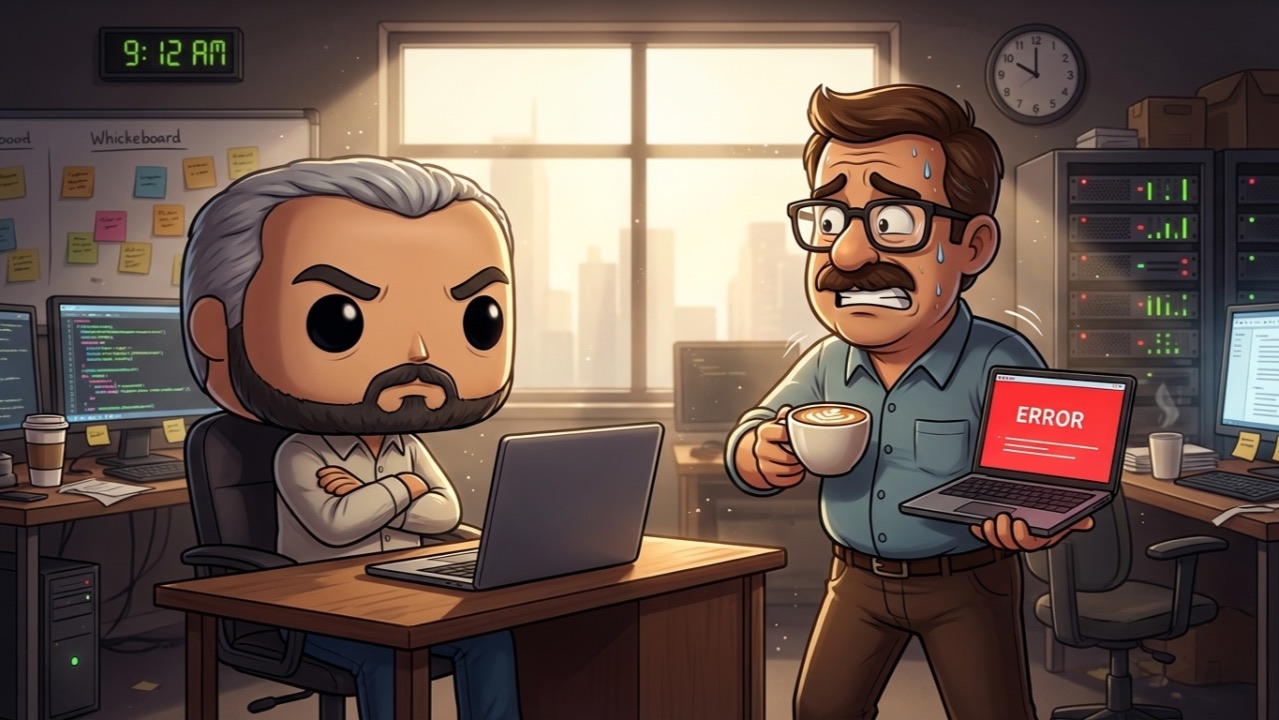
Tuesday. 09:12. The door opens with that strange stealth that only brings bad news wrapped in politeness.
Manolo walks in. This time he's carrying a cappuccino with a little flower on top... hasn't tried it yet... like natural intelligence... too late... we've moved on to the artificial kind.
Laptop open. Face of a man in anguish.
—Jose... —he says—, the demo with the big client has gone to hell.
—Explosion, fire, Russian hackers?
—No, no... nothing serious. Someone deleted the staging database and we're stuck with this little red screen you see here...
—Who?
—We don't know. But relax... I'm sure there was no ill intent.
There!!! Right there. In that sentence, soft as corporate flan, a kitten dies every time it's spoken.
Hanlon's razor puts it simply:
"Never attribute to malice that which can be explained by stupidity."
And Manolo uses it like a moral hall pass: nobody meant to make a mess, so nobody is responsible.
How delightfully daffy.
Perfect. Then let nobody learn anything either.
Because nobody here is bad. Everybody here is "a lovely chap."
The junior who deletes without a backup. The senior who approves without looking. The product guy who doesn't understand what he's approving but smiles a lot. The manager who doesn't ask questions so as not to look incompetent.
And Manolo, delighted. Healthy atmosphere. Zero friction. Zero judgment.
—Jose, the important thing is that nobody acted in bad faith.
—Correct, Manolo. We've just lost a client in good faith.
The modern company isn't destroyed by wicked villains. It's destroyed by polite incompetence.
People who don't know... but don't want to risk looking like someone who doesn't know either.
Everyone nods. Nobody reviews. Nobody raises a hand. Nobody wants to be "the nag."
And then the system goes on autopilot: small errors, constant, painless... until one day they're not painless.
Rita McGrath has an interesting concept, the illusion of stability: organizations that appear to work while quietly decomposing on the inside.
I just call it straight out: company policy based on not bothering anyone.
—Jose, we're not going to point fingers at anyone, it'll hurt our NPS.
—No, Manolo. I know. Around here we always point at the system... but never at the people operating it badly.
And that's how stupidity becomes structural. It's no longer a failure. It's a habit.
Every error that doesn't sting becomes permission for the next one. Every "no harm done" is a dress rehearsal for disaster.
And then come the tears:
—Jose, nobody could have seen it coming.
—Of course they could, Manolo. But the one who saw it kept quiet so he wouldn't look bad.
Frederick Brooks in The Mythical Man-Month hints (at least to me) that the biggest mistakes aren't born of bad intent, but of poor coordination among well-intentioned people.
The book insists that as the number of people in a company grows, the cost of coordination and communication grows non-linearly and becomes one of the main sources of problems and delays.
You don't need traitors. A room full of nice people who don't want to make anyone uncomfortable is enough.
And then the inevitable happens: nobody thinks out loud, nobody argues well, nobody protects quality, nobody defends judgment.
Only the atmosphere gets protected.
—Jose, we're a team here.
—Yes, Manolo. A team where nobody is guilty... until the client leaves.
This is where I catch Manolo... I sit him down and put both hands on his shoulders...
— Companies don't die from having conflicts, Manolo. They die from avoiding them.
Talent can take friction. What it can't take is mediocrity wrapped in misunderstood empathy.
—So... what do we do now about the demo? Should I fire someone to set an example?
—You're a dangerous man, Manolo... hold your horses... you already decided nobody was responsible, so nobody is going to learn anything. Try to make sure it doesn't happen again, so that in three months we don't end up with "another thing nobody did with ill intent."
Today's lesson for Manolo:
> Sustained incompetence is a slow form of malice.
A company doesn't sink because someone wants to wreck it. It sinks because nobody dares to say "this is wrong" out loud.
Thanks for reading.