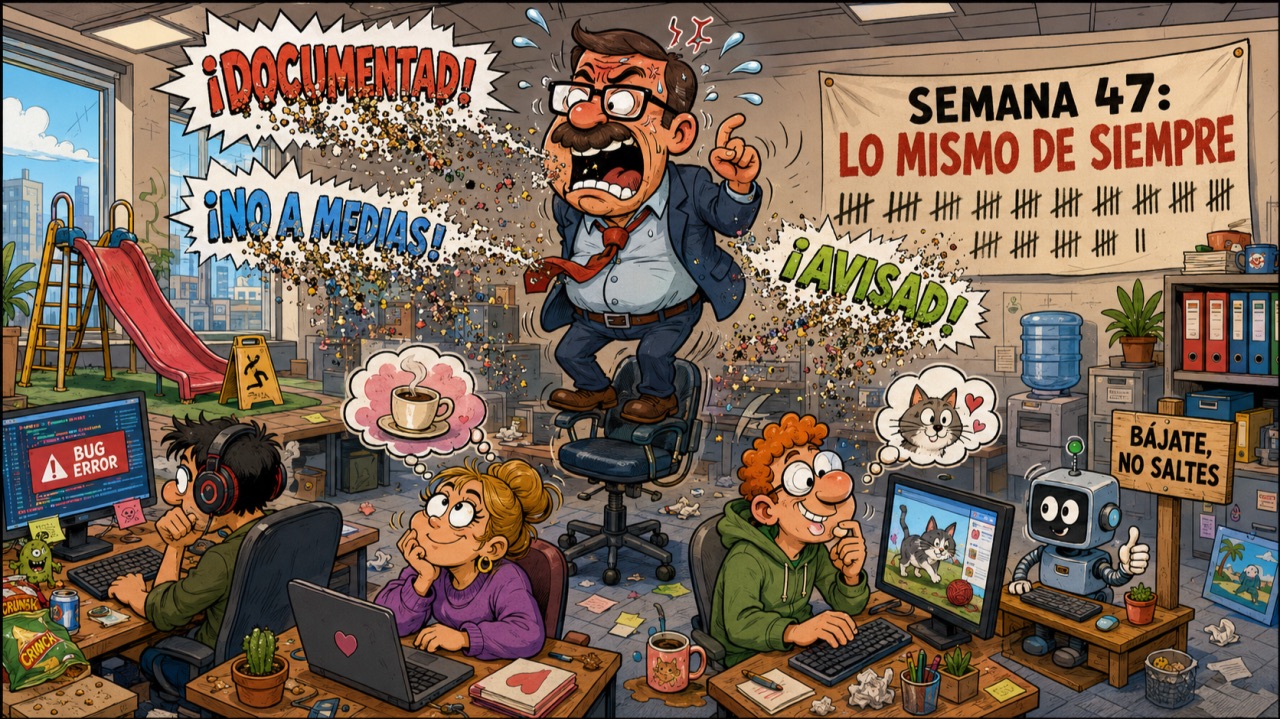
Monday. 9:15. Manolo walks in defeated. Not angry. Defeated, which is worse.
—Jose, I don't get it. I've been telling the team the same things for months. "Don't leave tasks half-done." "Document before you close." I say it in the daily, in the retro, in the one-on-ones. And nothing changes. Are they just not listening to me?
—Manolo, it's not that they're not listening. It's that you're talking at them. And talking doesn't change behavior. It never has.
—So what do I do, mime it?
—Sit down. I'm going to tell you something that was discovered programming artificial intelligence, and it's the best people-management lesson you'll hear this year.
Manolo sits down. Takes out his notebook.
—There's a technique for getting an AI agent to build software on its own. You give it a task, it does it, and the agent dies. Completely. A new one boots up, from scratch, with no memory of the previous one. No recollection at all. Every loop is a brand-new worker who knows nothing about the last one.
—And that works?
—Very well. But at first everyone makes your exact mistake. They see the agent make an error and they talk to it. They scold it. "Don't do this." And on the next loop, the agent makes the same error. Because it has no memory. The previous scolding doesn't exist.
—Sure, but that's a machine. My team remembers.
—Do they? When you told Sara three weeks ago, in a daily with fifteen people, "we need to document before closing"… do you really think she filed that sentence away as a permanent rule and reorganized the way she works?
—She should have.
—Sara heard one sentence among forty others that morning, while thinking about her bug, and ten minutes later it no longer existed. Not because she's bad at her job. Because a loose sentence, on an overloaded day, evaporates. And if that sounds exaggerated, look at the results: you've been repeating yourself for months and nothing has changed. The data sides with me, not with you.
Silence.
—Then how do they get the agent to improve, if they can't talk to it?
—They don't talk to it. They change its environment. And that's the sentence I want you to leave with, engraved: processes teach, sermons don't.
—Explain.
—The technique is called Ralph, after Ralph Wiggum, the kid from The Simpsons. Imagine Ralph builds a playground but comes back covered in bruises because he fell off the slide. What do you do?
—I tell him to be careful.
—And there's your problem. That's useless to Ralph, because tomorrow there's a new Ralph who doesn't remember your warning. What works is putting a sign on the slide: "CLIMB DOWN, DON'T JUMP". The sign is still there tomorrow. The new Ralph reads it. Nobody reads the scolding.
—A sign.
—You've spent months yelling at the slide. The job was to put up the sign. And in your world, the sign is three things you can do on Monday. All three mean the same thing: getting the rule out of your mouth and into the process.
—Tell me.
—One: the rule lives where the work happens, not where the talking happens. If "document before closing" matters, it's not a phrase for the daily. It's a mandatory checkbox that won't let the task close without documentation. The rule in front of the person at the moment of working, not floating in the memory of a meeting.
Two: the example within reach is worth more than the sermon. If you want them to document well, leave one task documented to an exemplary standard and say "this is the bar, copy it". People imitate what's in front of them far more than they remember what they heard.
Three, the most important one and the one that will sting the most: don't trust people telling you it's fine. Put up a gate that has no opinion. Does it compile? Does it pass the tests? If it doesn't pass, it doesn't get accepted. Nobody asks the person who did it whether they did it well, because everyone has an incentive to say yes. You ask "is it ready?" and trust the "yes". That's why half-finished work keeps reaching production.
Manolo writes. Slowly. For once, what he's writing is going to be useful.
—So I've been yelling at the slide.
—Every week. And here's the humiliating part: an agent that's dumb by design, with no memory, is better managed than your team. Because it gets the rule at the place of work, examples to imitate, and a gate that doesn't lie. Your team gets scoldings. A bash loop has a better management system than your department.
—That's harsh.
—It's precise. Which is different. And notice the irony: everyone believes AI will learn to be managed like people. It's the other way around. The right way to manage an agent is a perfect manual for managing people. Don't yell. Don't repeat. Don't trust the "yes". Change the environment, put the example in front of them, measure with an objective gate.
—And the summary? The team will ask why I'm suddenly changing.
—One single idea, Manolo: processes teach, sermons don't. Every time you catch yourself repeating something for the third time, stop. That repetition is the signal that you have failed, not that the team is bad. What matters doesn't get requested every Monday. It gets installed once and runs on its own.
—Stop repeating, start installing.
—Exactly. Good bosses don't repeat more. They repeat less. Because what matters, they've built into the process, the example, and the gate. And the process doesn't miss the daily, doesn't get tired, isn't in a bad mood on a Tuesday. It teaches always. You don't. You have your days.
Long silence.
—So my problem isn't that the team doesn't listen.
—Your problem is that you've confused saying with installing. Saying is free and evaporates. Installing costs more on day one and then works for you forever. You've spent years paying the expensive price —repeat, repeat, repeat— to get the cheap result: nothing.
Manolo closes his notebook. Gets up. For once, he doesn't argue. Before leaving, he turns around.
—Jose. If processes teach and sermons don't… why have I spent twenty years giving sermons?
—Because the sermon is easy and the process takes work, Manolo. Yelling in a meeting costs you thirty seconds. Designing the environment where people work well on their own costs you an afternoon. And almost every boss chooses, every single day, the thirty seconds. For twenty years. And then they wonder why nothing changes.
He leaves.
And I'm left thinking that today an artificial intelligence agent —dumb, memoryless, reborn every five minutes— gave Manolo the best leadership lesson of his career. No courses. No coach. Not a single management book.
Just a sign on a slide.
Which is, in the end, the only thing most teams need. And the thing almost no Manolo bothers to install. Because installing takes work. And yelling is free.
Until it isn't.
Thanks for reading.
While I'm at it, I wish you health, love, and family.
The rest doesn't matter that much… believe me.
We all know a Manolo. Sometimes we are the Manolo. A new one every Tuesday. Subscribe so you don't miss it.