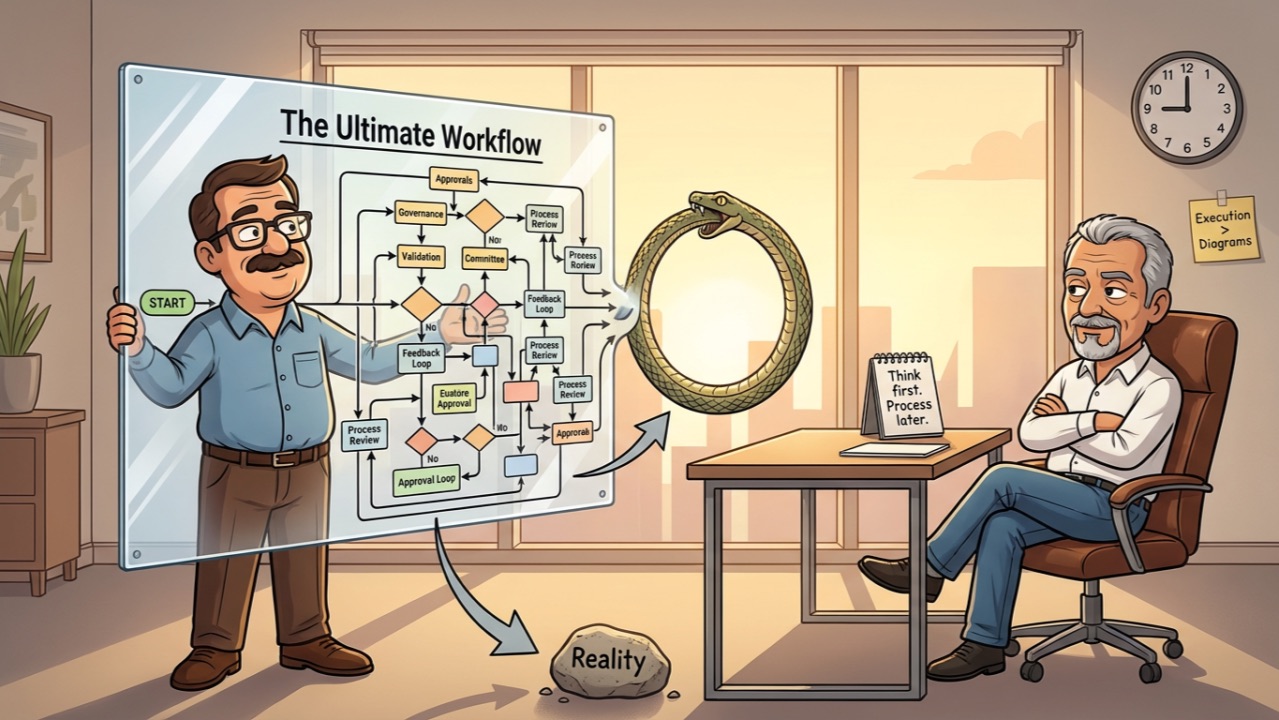
Tuesday. 09:00. My office door swings open as if summoned by Our Lady of Procedures. Manolo walks in with that usual energy of his…
—Man —he says, planting himself in front of me—, I've got it.
—Got what?
—The process map.
—What map, Manolo?
—The Business Process Model, man. The definitive BPM.
He sighs with pride. He pulls it out, printed, A3, in full color. And he slaps it down on my desk like it's a philosophical treatise.
There it is. An orgy of arrows, diamonds and rectangles connected as if the goal were to make somebody dizzy enough to sign. The sheet shines. Literally. He's laminated the damn diagram, dear god…
—This —he says, pointing at a box that reads “START”— is the flow of success.
—And this —I reply, pointing at an arrow looping back to the beginning— is an infinite loop. —No, that's continuous feedback.
—Manolo, that's Sisyphus with an MBA.
He smiles. He believes he has finally found the Holy Grail of efficiency. A line for everything, a box for everyone, and a green “OK” in every corner.
—Now everything will be under control, man.
—Under control or paralyzed?
—Don't be negative. Look, here we define every step.
—Right. And every step depends on three approvals and a committee.
—That's called governance.
—That's called gridlock.
Silence. The kind that lasts three seconds but weighs as much as an entire sprint.
Manolo crosses his arms. —Without processes there's no scalability.
—And without judgment, no process will save you.
I try to explain: A BPM doesn't give you clarity if there's no thinking behind it. It doesn't give you focus if you don't know what matters. And it fixes nothing if what you're doing has been wrong from the start.
But he's still convinced. —Jose, everybody does this.
—Sure, like smoking in the sixties. That wasn't healthy either.
The problem isn't the processes. It's that Manolo uses them like aspirin when what he needs is surgery.
The following Friday his email lands: “Subject: New version of the BPM (now with subprocesses).” I open it. The PDF weighs 11 megabytes. Only a great guilt weighs more.
On page 4 there's a diagram that reads: “Validate BPM results” > “Update BPM” > “Review BPM” > “Document BPM.” A loop. A perfect circle. The Ouroboros of consulting.
So I call him.
—Manolo, do you honestly think this is good for anything?
—For aligning the teams.
—And have they read it?
—No, but they have it in Notion.
—Of course. Like the Bible at home. Everyone owns one, nobody opens it.
Manolo doesn't do it out of malice. He does it because it gives him peace. The BPM gives him the illusion of control. The feeling that if something is drawn, it's solved.
But the business doesn't live in the diagrams. It lives in the execution. And the execution lives in the heads of people who understand why they do things, not just how.
So I tell him:
—Manolo, BPMs are for understanding a process, not for hiding it. There's no Excel, no diagram, no PowerPoint that can replace a conversation with the people who do the actual work.
Silence. Manolo nods. Or so it seems.
Until the next day a message lands:
“Subject: I've made a BPM for onboarding BPMs.”
And that's when I understood the problem wasn't the process. It was the faith.
A BPM is not a strategy. It's a snapshot of how you do things today. If you use it to justify instead of to learn, you end up optimizing the bureaucracy.
As Drucker said:
> “There is nothing so useless as doing efficiently that which should not be done at all.”
Or as I'd put it:
> “If your BPM needs a BPM, Manolo… maybe what's missing isn't more arrows, but more focus.”
And that's it for today's issue. I hope you enjoyed it.