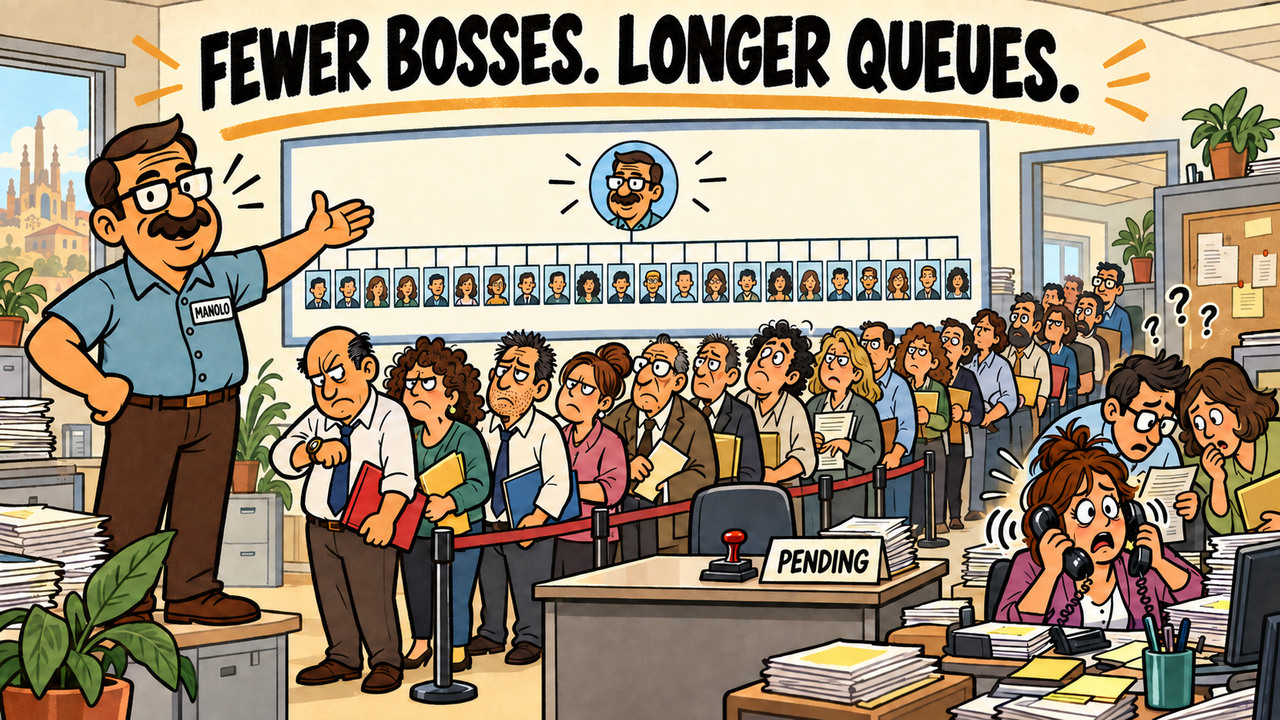
Monday. 09:18. Manolo is taking an org chart off the wall. He peels it away carefully, as though he is hoping to get his deposit back.
—Jose, we've removed a layer.
He shows me the new version. It used to have three floors. Now it has two. His photo is still at the top, the same size as before.
—Flat organisation. Fewer intermediaries. More autonomy.
—What have you changed?
—You're looking at it.
Yes. I am. One box has disappeared and the arrows are longer.
The box belonged to Elena, the customer service manager. They have moved her into sales. Her seven people now report directly to Manolo, who already had ten others.
—Seventeen people. That's leadership at scale.
Inés walks in with her laptop open.
—I need you to approve a refund of a hundred and eighty euros.
—I'm with Jose.
—The customer called on Thursday.
—Why didn't you sort it out on Thursday?
—Because Elena could no longer approve it and you were away.
Manolo looks at the new org chart. He cannot find that bit.
The customer received a table with a broken top. There are photos, an invoice and confirmation that it has been collected. Inés has everything she needs to process the refund except permission. Elena could approve up to three hundred euros. When they moved her, they removed her access. They did not give it to anyone else.
—Email it to me, then.
—I did. On Thursday.
—Forward it again.
Inés returns to her desk. The customer has spent four days waiting for a more agile company.
—People have to get used to change —says Manolo.
—Who has Elena's approval authority now?
—I do. For the time being.
—Until when?
—Until things get moving.
The system will therefore get moving once the only person who can move it finishes explaining that it now moves by itself.
Manolo shows me a news story. On September 2, Uber announced a reorganisation to remove layers, bring teams together and clarify who makes decisions. Its statement described too much time spent coordinating, fragmented ownership and teams with only one or two people per manager. It also announced a workforce reduction of around 10%.
—Everyone's doing it.
—It says they're also clarifying who decides.
—We'll work that out as we go.
He has copied the bit you can draw.
Uber's announcement describes what the company intends to change. It does not yet prove that it has achieved it, or tell us how many people Manolo should manage. But he has already turned someone else's decision into a template.
I suggest we look at what Elena did before he removed her box.
—Coordination —he says.
—That's a word. What did she do?
We go to see her. She is trying to call a new customer. She has five unread internal conversations and a colleague leaning on her desk.
—Elena, just a quick one.
She closes her eyes. It must be the sixth quick one of the morning.
—What do you need?
—The workshop says it can repair the table. The salesperson promised a replacement. What do I tell the customer?
—Ask Manolo.
—He told me to coordinate with you.
Elena looks at us.
—But I'm in sales now.
—It's a transition —says Manolo.
—The sales target isn't in transition. You've given me the full one.
We sit down. Elena opens her old diary. She approved refunds, settled disagreements with the workshop, reassigned cases when someone was off and reviewed difficult cases with new starters. She also prepared a weekly summary that went through her, Manolo and senior management.
—That last bit really was unnecessary —she says—. Management gets the same figures in the system.
—Then we'll drop the summary —Manolo suggests.
—We're still sending it. You changed the org chart, not what you ask us for on Fridays.
There is work here that can be removed and work someone still has to do. Manolo has moved the person without distinguishing between them.
—So Elena was indispensable.
—Elena was doing things you haven't reassigned —I tell him—. That's different. If every refund needs a manager, perhaps we can improve that too.
Elena nods.
—Inés has been handling these cases for four years. A broken table with photos and a confirmed collection? She knows exactly what to do. She passed it to me because I had the permission.
—What if she makes a mistake?
—I could make mistakes too.
Manolo goes quiet. He had never considered that the box included that possibility.
A Korn Ferry survey published on September 8, covering more than 16,000 professionals across eleven markets, captures this pressure: 55% of managers who remain after cuts say they are exhausted. That is a survey response, not proof that removing any manager makes a company worse. It is a reason to ask where their workload ends up.
Here, the answer is on Elena's phone and in Manolo's inbox. The savings come with notifications.
We return to Inés's refund. They agree she can handle documented cases of this kind herself up to three hundred euros, recording the reason. Finance will adjust her permissions, and they will review the first cases together. Exceptions will go to Manolo; when he is away, a designated person will have the authority to resolve them.
—And the workshop issue? —Elena asks.
—Inés can handle that too.
—On top of everything else she's doing?
Manolo sighs.
—Nothing's ever good enough for you.
—You asked who does it. We're asking when.
They pull up the case list. The disagreement between the workshop and sales keeps happening because each promises the customer something different. They decide to establish a shared rule for those cases and name who decides when a case falls outside it. Until then, Elena will set aside a specific amount of time for the handover. That time will be deducted from her sales workload.
The Friday summary disappears. Actually disappears. Manolo writes to senior management to tell them where they can look up the figures.
Not everything gets resolved that morning. They still need to decide who supports new starters and who reorganises the work when someone is absent. They write it down with names and dates. For the first time, what is missing has more detail than an arrow.
—How do we know whether this works? —Manolo asks.
—Look at how long a refund waits —says Elena—. How many come back because they're wrong. And how many queries still land on my phone after moving me to sales.
—We don't count the layers —I add.
Manolo returns to his office. He has seventeen people reporting to him and a meeting he is already late for. The number feels less modern than it did at nine.
Inés appears at the door.
—Today's refund still needs your approval. They're changing the permissions this afternoon.
This time he opens the email. Looks at the photos. Approves the hundred and eighty euros. Inés leaves to call the customer.
The reorganisation presentation is still on his screen. Manolo moves an arrow so that it does not cross another one.
—That's cleaner —he says.
From the doorway, Elena points to the next email.
—Yes. Sixteen to go.
Thanks for reading.
We all know a Manolo. Sometimes we are the Manolo. A new one every Tuesday.