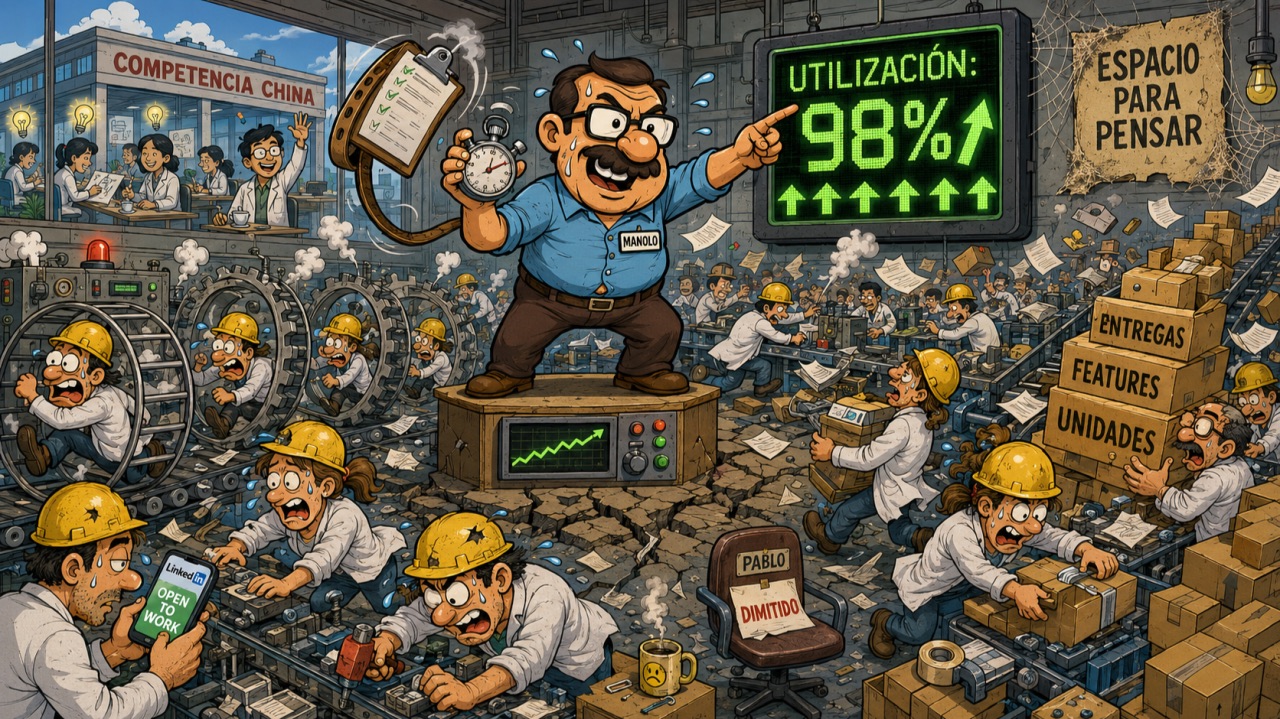
Tuesday. 9:00. Manolo walks in with a dashboard. He turns it toward me like someone showing an X-ray of his collarbone.
—Jose, look. Team utilization at 98%. Quarterly record.
—Manolo, that's not good news. That's the warning light.
—What do you mean, warning light? We've been demanding efficiency for months. The team is delivering. No gaps. No dead time.
—Exactly.
Manolo sits down. The face of a man starting to hear something unpleasant.
—Manolo, what has your team come up with this month?
—They've shipped the new line, integrated two suppliers, cleaned up the documentation...
—I didn't ask what they've executed. I asked what they've COME UP WITH. What hypotheses have they brought you. What customer problem have they discovered. What experiment have they proposed.
Silence.
—Well, they've been busy delivering.
—Exactly. And that's why they've stopped thinking. Not because they're stupid. Because you've taken away the only space where thinking happens.
—What space?
—Slack, Manolo. The gap. The air. The unscheduled time where someone tells you "this makes no sense, what if we tried it this way?". The afternoon where they discover, without you asking, that the real problem was something else entirely. That. And you've eliminated it.
Tom DeMarco distills it in Slack: an organization at 100% occupancy is an organization that can no longer learn, or change, or absorb variability. It works like a highway at full capacity: the moment one car brakes, everything jams.
—But the data says we're delivering more than ever.
—Manolo, that's the trap. Utilization goes up. It shines. The CFO loves it. And it's anticorrelated with the health of the team. Because at 100% there's no time for what matters: understanding the problem before solving it, learning from a failure, rethinking an idea in the light of new data. Invisible work. That compounds.
—But we can't stop.
—I'm not asking you to stop. I'm telling you that the pace you're running at is exactly the pace anyone can run at. Which is why it's the pace you'll lose at. It doesn't differentiate you. It makes you interchangeable.
—And why do you think you've started squeezing them like this?
—Because things are hard. The Chinese have come in 40% cheaper. We're losing contracts we'd held for fifteen years.
—Exactly. And that's the tragic part. When you see a competitor stepping on your neck on price, your instinct is to demand more speed. More units. More efficiency. And that gives you the feeling of doing something. The problem is that the only real way out isn't producing cheaper. It's finding the angle where the Chinese can't compete: service, integration, warranty, data. And that work is discovery work. Uncertain. Which needs exactly the space you're denying them.
It's the sigmoid curve, Manolo. You're optimizing to accelerate a curve that's dying, instead of jumping to the next one. And the pressure you think is saving you from the cliff is precisely what's cutting off your legs so you can't walk around it.
—And how do I do discovery if I have to deliver?
—By reserving time. One day a week. One Friday a month. Whatever. But you block it. And you protect it. Because if you leave it up to the team, it will never happen: when the whole system pushes toward delivery, nobody has the courage not to deliver.
—That's very hard to defend in front of the board.
—I know. That's why almost nobody does it. And that's why almost every company in your situation is going to disappear. Not because they're bad. Because they're trapped in a regime that won't let them discover the one thing that would save them.
—And what do I lose if I don't do it?
—Three things. Your best people, first. People with options don't stay in an output factory. The ones who stay are the ones with nowhere else to go, and with them you lose your ability to discover in the future. It's a ratchet.
Second: you lose capital. Technical knowledge, the deeply understood customer, the differential expertise. Under delivery pressure it gets converted into output that depreciates. You're eating your seed corn. And seed corn doesn't come back. You have to plant it again. And planting takes years.
Third, the worst one: you lose the capacity to know. Without slack there's no experiment. Without experiment you don't know whether your team is capable. You start flying blind. With green dashboards. But blind. Pure Goodhart: when the metric becomes the target, it stops measuring anything.
Long silence.
—So I'm destroying the team with good intentions.
—You're destroying it with the CFO's intentions. Which is worse.
—That's harsh.
—It's precise. Efficiency has a hidden cost that only shows up in hindsight. Too late is when the good ones are already gone and you don't even know what to experiment on, because nobody has experimented on anything in two years. You reach the end of the tunnel and discover you no longer have a car.
—So what do I do on Monday?
—You go to the team and tell them something they haven't heard in two years: "Next Friday, nothing ships. Talk to five customers, look at three competitors, and the following Monday bring me a hypothesis." And then, the hardest part: you don't interrupt. You don't supervise. You trust.
—And if nothing comes out of it?
—Something will. And if nothing comes out the first Friday, it will by the fourth. But if you don't do this, in eighteen months you'll be in front of the board explaining why the company missed the train. Not for lack of deliverables. From an excess of them.
He stares at the dashboard. The 98% is still there, perfectly green.
—I'll think about it.
—Think about it this way, Manolo: 100% utilization isn't efficiency. It's the institutionalization of fear. You're so afraid of the falling curve that you've optimized to accelerate it, instead of protecting the space to jump to the next one.
He leaves.
And I know that on Friday there will be deliveries. As always. And a green dashboard. And a happy board. And a team that walks in every Monday with a little less fire, a little fewer ideas. Until the day the best of them opens LinkedIn and discovers there's another company where people are still allowed to think before they deliver.
Because full utilization doesn't destroy a team in one blow. It destroys it in silence. Sprint by sprint. Until the only ones left are the ones who accept that not thinking is normal.
And by then, Manolo, it's not that the talent has left. It's that the conditions where talent used to show itself have left.
And those, unlike talent, can't be rehired.
Thanks for reading.
While I'm at it, I wish you health, love, and family.
The rest doesn't matter that much… believe me.
We all know a Manolo. Sometimes we are the Manolo. A new one every Tuesday. Subscribe so you don't miss it.