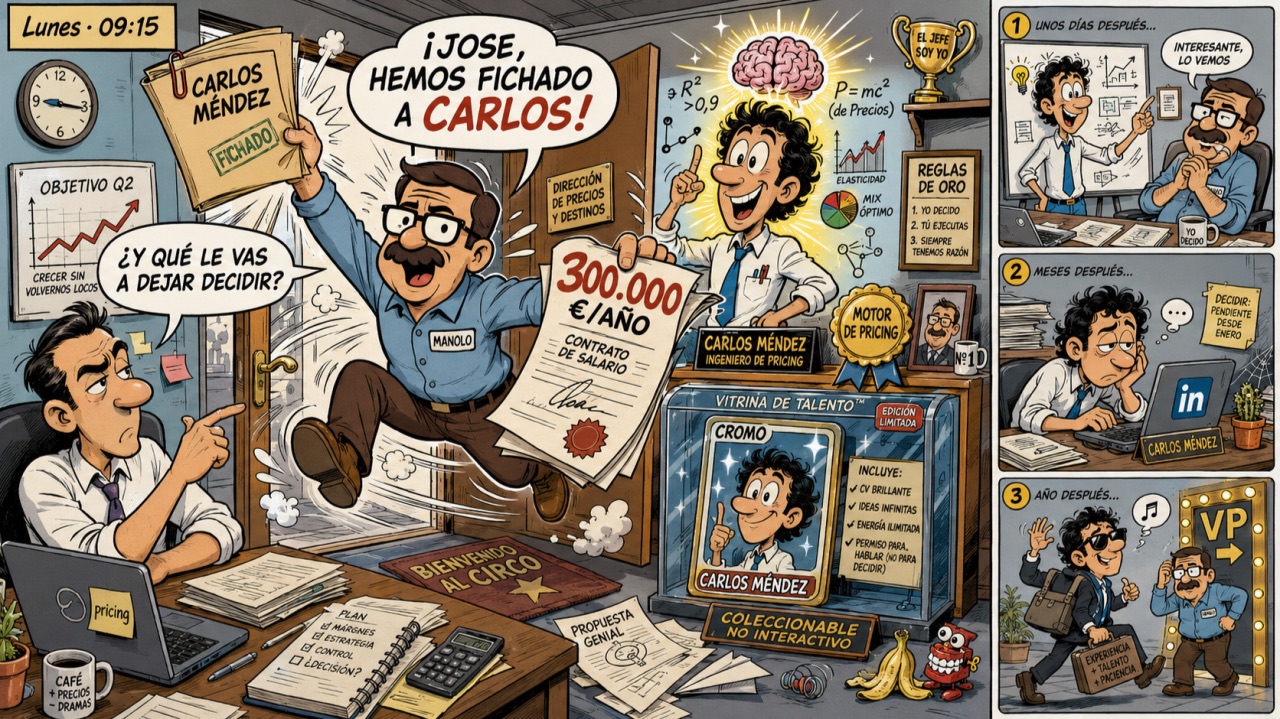
Monday. 09:15. Manolo walks in with real drive. The same drive Lola Flores had when she asked every Spaniard for one peseta.
—Jose, we've signed Carlos.
—Which Carlos?
—Carlos Méndez. The one who designed the pricing engine at that scaleup that sold for 200 million.
—Manolo, that guy is brilliant. And expensive.
—Five times the team's average salary. But he's worth it. A phenomenal mind.
—And what are you going to let him decide?
Silence.
—What?
—I asked what you're going to let him decide.
—Well… he'll collaborate. Contribute. Advise.
—Manolo, you've signed one of the country's top technical brains. And you're telling me he's going to "advise". Advise whom, exactly?
—Me. Us.
—Meaning, he's not going to decide anything. He's going to give opinions. And then you'll decide whether his opinion matches the one you already had.
—Strategic decisions…
—…you make. You, who are less brilliant than he is. Which is why you signed him. But you're not going to let him decide. Do you realize what you just paid for?
Pause.
—Manolo, do the math. Carlos costs you 300,000 a year, against the 60,000 of an average profile. You've paid 240,000 EXTRA for his brain. For his ability to think better than you. And you're going to sit him down to "advise". Congratulations. You've just paid 240,000 for the privilege of not listening to someone who earns that much because he thinks better than you.
—I do listen.
—Manolo, "listening" isn't "hearing while you wait for your turn". Listening is accepting that the other person may be right even if it makes you uncomfortable. And that you don't do. Three months ago Pablo proposed a brilliant solution for the notification system. He was right. You said "we'd look into it". You never looked into it. Carlos is going to be the next chapter.
—That's an exaggeration.
—Let me tell you how the movie ends. Carlos will arrive. He'll observe for two weeks. He'll identify three structural problems you hadn't managed to see. He'll propose solutions. You'll say "interesting, we'll look at it". You won't look at it. Three months in, he'll propose it again with more data. You'll say "now is not the moment". At six months he'll stop proposing. He'll do the minimum. He'll open LinkedIn more than he should. Within a year he'll leave. And you'll say "strange, he didn't fit".
—Then what do I hire a brilliant person for?
—To look like a strategist in front of the Board. "I've signed Carlos Méndez." Sounds great in the deck. Justifies the headcount. But hiring brilliant people and not letting them decide is the most expensive way of lying to yourself. For that, it's cheaper to hire the most junior person. Same result. You save 240,000 a year.
—That's very harsh.
—It's mathematical. If you're going to make every decision yourself, it doesn't matter who proposes them. You're going to do whatever the hell you please.... The difference between the junior and Carlos, in your management model, is only the invoice.
Jim Collins distills it in Good to Great: rule number one for real leaders isn't strategy. It's building a team where people more brilliant than you can exercise their brilliance. If you're not willing to let them decide, you don't lead. You collect talent the way people collect trading cards: it shines in the display case, but it never plays a single game.
—And what do I do with Carlos?
—I'll give you a test. Next week, in the first technical review, Carlos is going to disagree with you on something concrete. Guaranteed. When it happens, you have three options.
One: give in because he's right. That is, let him decide.
Two: argue it out with him, accepting you might be wrong, and reach a joint conclusion.
Three: file the comment away with an "interesting, we'll look at it" and then do what you had already decided.
If you do one or two, you've signed Carlos. If you do three, you've signed a trading card. And it will only be a matter of time before the card ends up in another album.
—But he doesn't have my context.
—Carlos doesn't have your context. You don't have his brain. That's the TRADE. You bring context. He brings judgment. If you keep the context AND the judgment, what did you sign him for?
Silence.
—I'll think about it.
—Think about it, Manolo. Next time you tell the Board "I've signed the best", make sure you're going to let the best do his job. If not, don't sign the best. It's outrageously expensive. And the result is the same as with a junior.
He leaves.
And I know that in six months he'll tell me Carlos "didn't work out". That he "didn't fit". And within a year Carlos will be a VP at another company. Manolo will announce another signing. Another brilliant mind. Another invoice.
Another trading card in the display case.
Another album that will open, a year from now, at another company.
Thanks for reading.