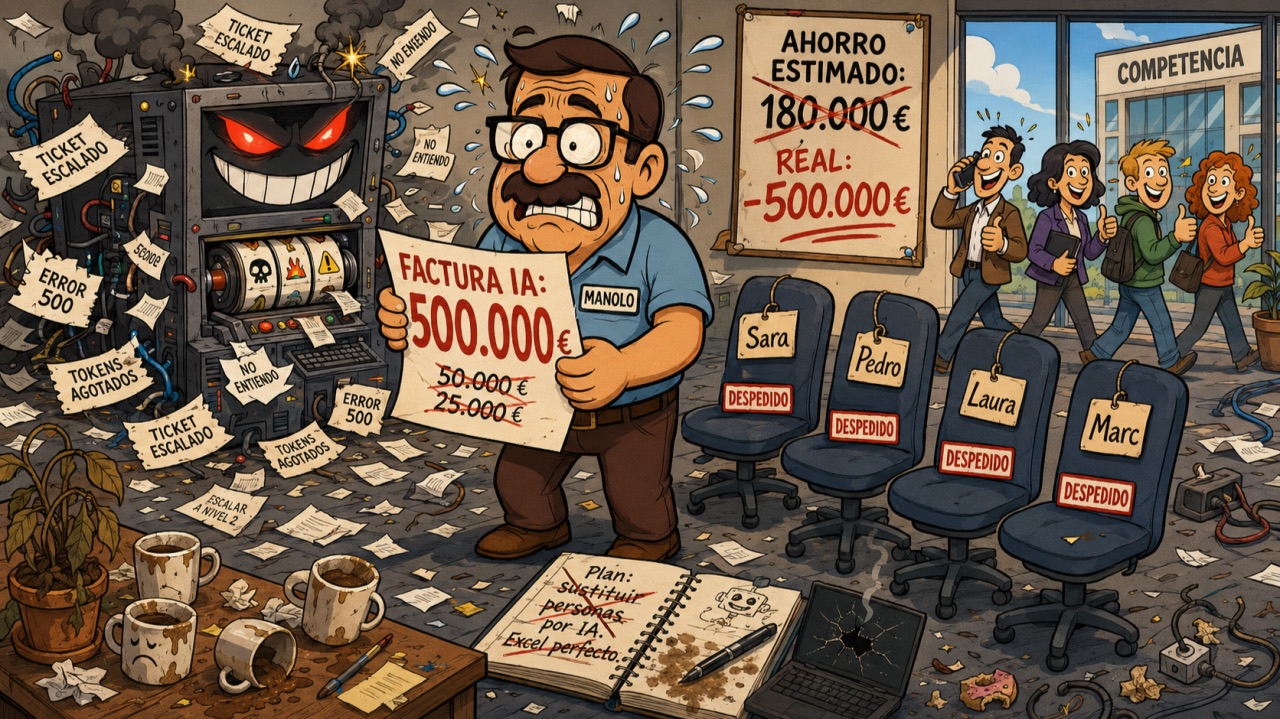
Monday. 09:30. Manolo walks into my office with a face I'd never seen on him.
—Jose, we have a problem with the AI.
—What AI?
—The one we brought in to replace the level 1 support team. The one that was going to save us 180,000 euros a year.
—And?
—It's been running for six months. And this month it cost us 92,000. This month alone.
—In total?
—Almost half a million.
—Manolo, you fired four people to "save" 180,000. And you've spent half a million on what was supposed to replace them.
—Yes.
—And what does the AI do?
—The same thing they did.
—The same thing, Manolo? Or what you thought they did?
Silence.
And there it is. Manolo, like almost every manager, looked at Sara, Pedro, Laura and Marc from his chair and saw four people answering tickets. Password resets. Configurations. Dumb questions. Calculator in hand, he thought: "an AI can do this for a few cents per query." He multiplied. Gorgeous Excel. And signed the layoffs.
What Manolo didn't see is that those four weren't answering tickets. They were solving problems. Which is a different thing.
—Manolo, what percentage of the tickets were actually level 1?
—What, 80%?
—47%. The rest were level 2 in disguise. Sara labeled them level 1 because she solved them herself. And she solved them because she knew the customers. She knew Carlos from Logistics always had VPN problems on Mondays. She knew the Madrid team was on the old version because the manager there refused to update. She knew that trivial ticket from the big client came with a passive-aggressive email from the CTO saying "this is the third time this month."
—Those are details.
—No, Manolo. That's context. And context was the only thing that cost money there. The mechanical work costs the same in an AI and in a person: practically nothing. What costs money is knowing WHAT to do and FOR WHOM. Sara had that. And you threw it out the window with her severance.
—But AI learns.
—AI learns patterns. It doesn't learn context. And that's the most expensive problem in the world of enterprise AI. You buy AI thinking it replaces work. And AI replaces output. What it does NOT replace, and that's why it's costing you six times more, is context.
Erik Brynjolfsson explains it in The Second Machine Age: the real productivity of technology isn't measured by what it automates, but by what it amplifies. The companies that win aren't the ones that replace humans with machines. They're the ones that combine both. The ones that only replace end up discovering they eliminated the wrong asset: the human context that made the task valuable, not the task itself.
—Do you know how many tickets the AI has escalated to level 2 in six months?
—No.
—71%. Sara escalated 9%. The difference is the calls, the emails, the complaints, the emergency meetings the level 2 team now holds to fix what the AI doesn't understand. And that cost doesn't show up in your savings Excel. But it shows up, month after month, in their payroll.
—But we did a business case.
—You did an Excel, Manolo. Which is not the same thing. You compared the salary of four people against the cost per query. You forgot three things.
The first: the cost per query isn't linear. When the query is complex, the AI iterates, burns tokens, returns answers the user has to ask all over again. Every "easy" query costs little. Every "average" query costs twenty times more. And almost all the real ones are average queries disguised as easy ones.
The second: the queries your AI doesn't solve get escalated to people. Whom you pay. And those people, receiving badly triaged queries, take longer.
The third is the worst: you've lost the context Sara and the others built over years. That can't be bought. There's no SaaS that gives it back. A year from now, when you hire someone to replace the AI, they'll need eighteen months to reach Sara's level. That's your real bill. And it doesn't show up in any Excel.
—So what is AI for, then?
—To amplify the people who have context. To free them from the mechanical work and let them do high-value work. Not to replace them. When you replace them, the context leaves with them. And context, Manolo, is the one asset AI cannot generate.
—But then how do you save money with AI?
—You don't save. You produce more. With the same people. Who deliver more, better, and with less effort on the mechanical stuff. Firing people to bring in AI is like selling your muscles to buy weights.
—I'm writing that down.
—Write it down. But first, go to Operations and tell them to stop the migration of the second team. Because if you do it, in six months the bill won't be half a million. It'll be two. And you won't be explaining it to me anymore. You'll be explaining it to the Board.
He stares at his notebook. Pen still.
—I'll think about it.
—Think about it this way, Manolo: AI isn't expensive. What's expensive is not understanding what you're replacing. And so far, you've understood that about almost nothing.
He leaves.
And I know he'll be back. Because Manolo doesn't learn from one case. He learns, if he's lucky, after three. And in six months he'll tell me the same thing about the procurement team, where he's thinking of setting up "an AI agent to automate negotiations with suppliers." As if negotiating were a process. And not a relationship.
Because to Manolo, AI is an Excel that moves on its own. And that's why it costs him so much.
Thanks for reading.
Let me also wish you a good week.