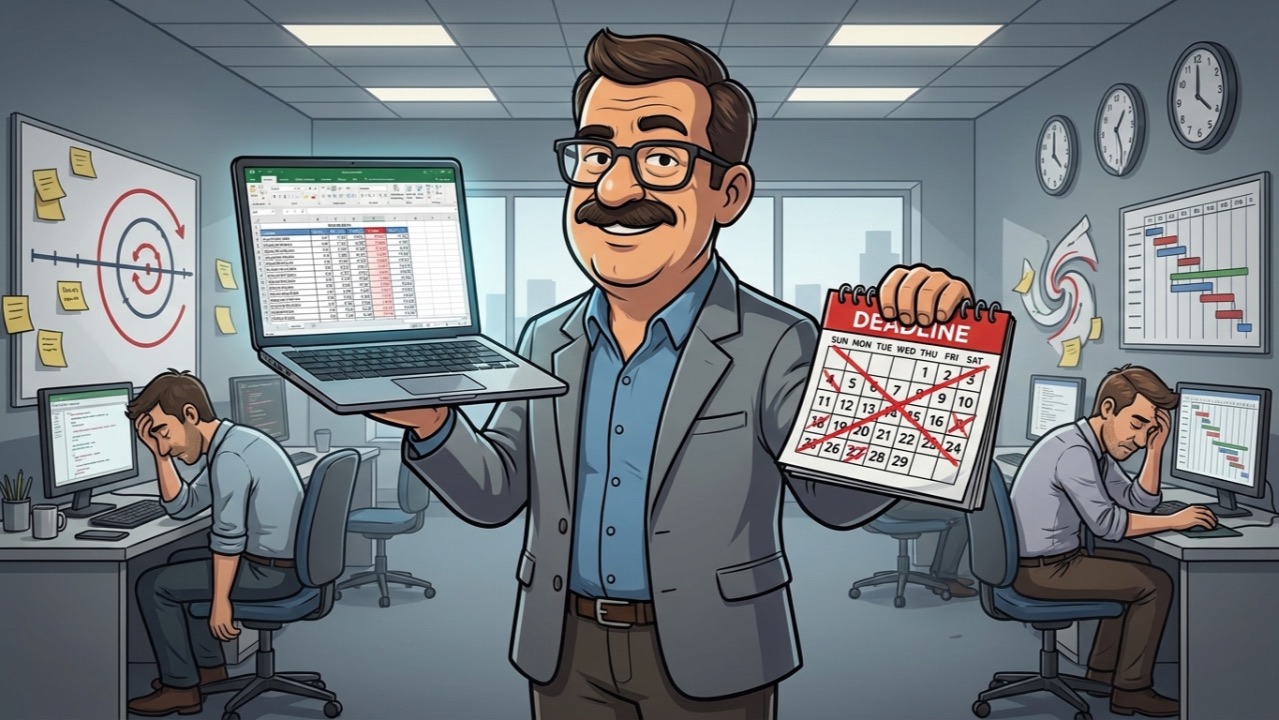
Monday. 09:00. My office door opens with that dry clack that already puts me in defensive mode. In comes Manolo. Laptop in one hand, coffee in the other, wearing his "this weekend I discovered something that will blow your mind" smile.
—Dude —he says without sitting down—, I've got it. I know how we're going to be much faster.
—Lots of Sunday-night videos, huh?
—Parkinson's law, Jose. "Work expands to fill the time available." So no more slack. If something can be done in three weeks, it gets done in three days.
Silence.
—Manolo... —I tell him—, you've just discovered an administrative law from 1955 and you're using it as if it were Newtonian physics.
—But it's true. Give people less time and they run.
—Yes. And if you cut the brakes on a car going downhill, it runs too. Until it plows into your favorite bar, the one where you have your beers.
Manolo frowns. He's convinced he's right. That's the dangerous part, but I've seen him like this before; I think I can handle it.
—I didn't make this up —he continues—. The good consultin' firms use it, McKinsey, BCG, those people who dress so well.
And there's the important nuance. Not the law. The bad copy of the law.
—Manolo —I explain—, Parkinson never said "squeeze them and be done with it." He said that when there's no clear definition of the work, time inflates to fill the void. It's a critique of bureaucracy, not a recipe for blowing up teams.
He opens the laptop. Shows me a plan. Aggressive dates. Crossed dependencies. Unvalidated assumptions. Everything looks very decisive... and very... poorly thought out.
—Look, Jose, this module in five days.
—Which module?
—The new one.
—And what does it do?
—The basics.
—What is "the basics"?
—Well... we'll figure that out as we go.
And there's the trick.
Parkinson's law only works when you know exactly what you're doing. When you don't, all you achieve is accelerating the confusion.
When you compress time without reducing complexity, you don't gain speed. You generate rework, extra coordination, and invisible errors that blow up later.
—But if we give them more time, they slack off —Manolo insists.
—No, Manolo. They slack off when there's no judgment. Time doesn't create laziness. Ambiguity does.
Manolo crosses his arms. A sign of passive resistance.
—So what do you propose? Long deadlines?
—I propose honest deadlines. Deadlines tied to decisions made. Deadlines born after understanding the problem, not before.
I tell him what Hofstadter already explained: everything always takes longer than expected, even when you take into account Hofstadter's law. Not because people are slow, but because intellectual work isn't linear.
And also what Donella Meadows taught: pushing a complex system without understanding its delays doesn't speed it up, it makes it unstable — and watch out for this one: cranking up the system's gain by cutting deadlines can tear it apart.
I learned this well from Ogata's discrete-time control systems, never thought that course would have a business application. In the end it's about connecting dots, but they usually connect at the end, as Jobs said.
You generate that chaos you later call "lack of commitment."
—But we need a sense of urgency —he says.
—Urgency without definition isn't leadership. It's organizational anxiety. I've lived it.
He goes quiet. Good sign.
—So... is Parkinson's law a lie?
—No. It's dangerous when misread. If you cut time after clarifying scope, you trim fat. If you cut time before, you're just hiding ignorance under pressure.
He closes the laptop more slowly.
—Okay... now what?
—Now we do the opposite of what you wanted to do: we define the problem properly, cut scope for real, and deliver something small that works. And then, if you want, we squeeze. But with our heads on straight.
Before leaving, Manolo turns around:
—So... we're not slow?
—No, Manolo. We're complex. And that isn't fixed with stopwatches.
The door closes. The coffee is still hot. And the system, for today, survives.
This week's lesson for Manolo is clear:
> Parkinson's law isn't a whip. It's a mirror. If everything takes too long, don't look at the calendar. Look at whether anyone truly understands what they're building.
Thanks for reading. Onward