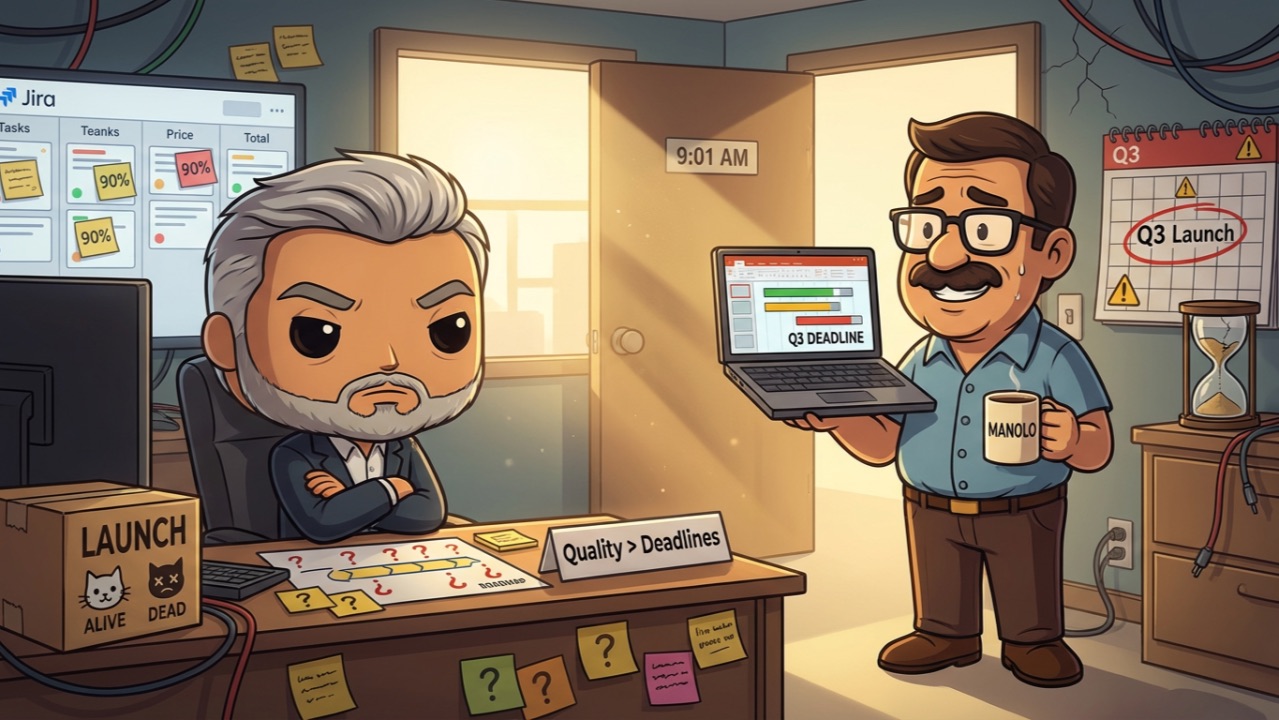
09:01. The door opens without a knock. That alone is a sign.
Manolo walks in with his laptop open, not closed. This time I see a PowerPoint marching ahead of him, like a battle standard. The face of a man who has just invented gunpowder...
—José —he says—, we need to commit to a date.
Not "talk about dates." Not "explore scenarios." Commit, damn it!!
—To what, exactly? —I ask, buying time.
—The new product.
—Which one?
—The AI one, obviously.
Obviously.
Manolo sighs. That blend of patience and moral superiority found only in people who believe complexity gets solved by squeezing the calendar harder.
—Without dates there's no focus, Jose.
There it is. The phrase. The incantation.
Putting a date on something you don't understand isn't management. It's astrology with KPIs. But Manolo has watched enough videos to feel prepared.
Three days later the document arrives. PRD\_v0.1\_FINAL\_DEFINITIVO\_v7. I open it.
"The product must be usable, scalable, and ready before the end of the quarter."
Speechless.
Nothing about who it's for. Nothing about why. But it's done this quarter... impeccable.
—What is this? —I ask him.
—Vision.
—This isn't vision, Manolo. This wouldn't make the cut with the product managers I interview...
Manolo smiles. He thinks I'm exaggerating. He thinks building product is like manufacturing screws: you define the process, adjust the deadline, and done. I explain —again— that we don't manufacture known things here. Here we try to discover something that works before we run out of patience, money, or talent.
—But in sales we close deals with dates —he says. —
Because we sell things that already exist.
—And in finance we close the month.
—Because numbers don't change their minds.
—Then why can't product do the same?
—Because what we build doesn't know what it is until someone tries to use it.
Manolo nods, but he's not listening. He's already thinking about the "Immovable timeline" slide.
Near the end of the quarter, the Jira board looks like a car crash. Everything is at 80–90%. Nobody quite knows of what, but it's reassuring. 90% is that magical place where the work looks done and doesn't hurt yet.
And then, when you deliver, you spend as long finishing that 10% as you did doing the 90%... and those of us who work in product know it, but nobody says it... and the problem is that many DON'T DO IT...
—We're on track —Manolo says in the daily—. Progress is solid.
—What does "solid" mean? —someone asks, naively.
—That we shouldn't worry.
Perfect. The ultimate metric: "not worrying."
The deadline arrives. Q3. Manolo shows up relaxed. Too relaxed.
—We made it —he says.
—Made it where? —To the deadline.
The product opens. Sometimes. It does things. Some it doesn't. Marketing has already published the post. "Successful launch." The engineering team exchanges silent looks. Nobody wants to be the first to say the emperor is in beta.
The product is alive and dead at the same time. It works... if you don't use it. Schrödinger would be proud.
Manolo isn't a bad person. That's the problem. He believes the deadline creates discipline, when all it creates is fear of telling the truth. He believes cutting time cuts uncertainty, when all it does is hide it better.
What Manolo doesn't see is that Parkinson's law and Hofstadter's law aren't excuses to squeeze harder. They're warnings. Notices that time in complex systems doesn't behave the way he thinks it does.
A product treated without care ends up without a soul. You have to spend that 90% on that 10% so it doesn't get "enshittified," but many companies think that adds no value to the P&L
I explain it to my son like this:
—If you don't brush your teeth every day, your teeth won't fall out tomorrow, or next month, or next year. But in ten years they will...
> Digital product is the same: if you don't finish each iteration with care, with attention to detail, even if that last 10% doesn't make money in the short term, nothing will happen to you in year one, or year three. But in the long run your product's teeth may well fall out, and you'll have to fit it with dentures.
To hit a deadline you can negotiate scope, but never quality.
Have a good week.