PS: This edition follows a friend's advice. Today Manolo is the one scolding me.
Tuesday. 09:15. This time it's ME walking into Manolo's office with an evangelist's stride. MacBook under my arm. Three tabs of architecture diagrams open. And that expression of a man who has just rescued a kitten from the jaws of a bulldog.
—Manolo, mission accomplished. I've convinced the Nexova folks to stop and rebuild the architecture from scratch.
—Stop? For how long?
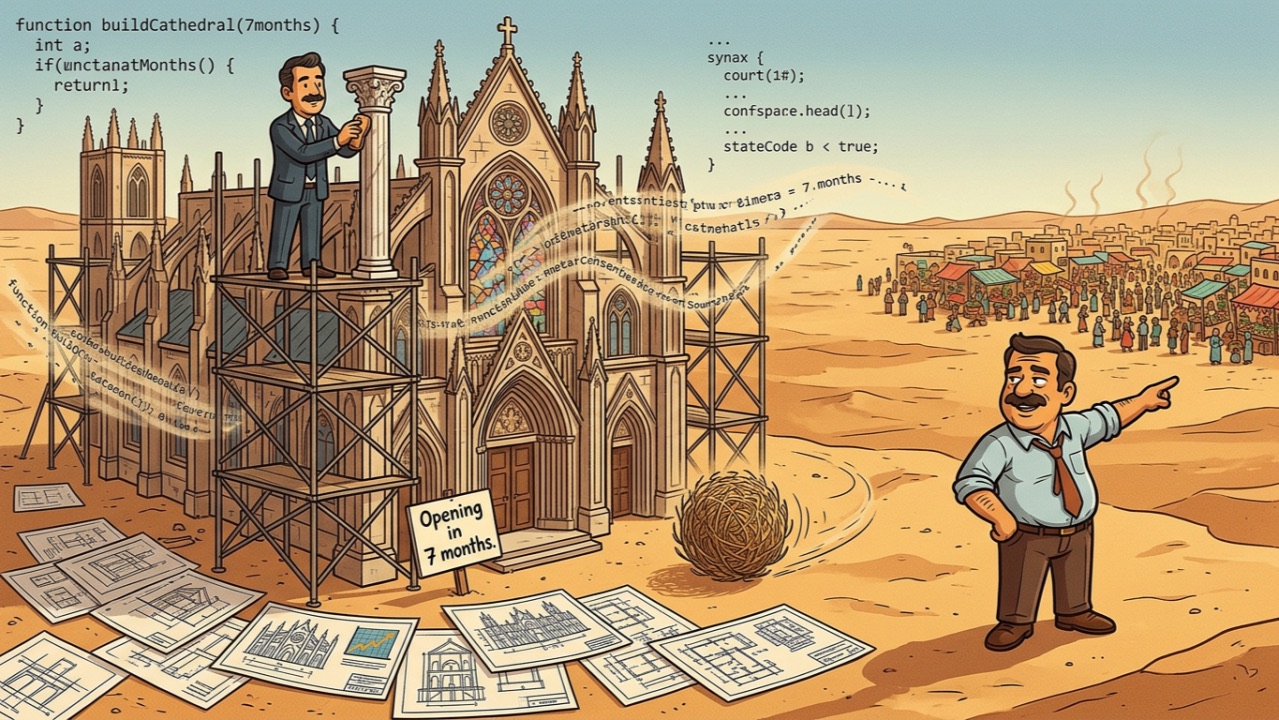
—Six months. Maybe seven. But when they're done they'll have a solid foundation. Properly decoupled microservices, API gateway, event sourcing, 90% test coverage. A cathedral, Manolo. A cathedral.
Manolo looks at me. Sets down his coffee. Leans back in his chair. And does something I wasn't expecting:
—How many users do they have?
—About three thousand. But that's not what matters, what matters is that…
—And how many will they have in seven months with the product on hold?
Silence.
—Jose, how many are they going to have?
—The same, but with a platform that scales…
—Scales to what? To the three thousand who no longer remember why they signed up?
I wasn't expecting this from Manolo. Manolo, the exclusive-contracts guy. The evaporating-moat guy. The guy who comes to me so I can explain things to him.
But Manolo has been reading for months. And what he says next disarms me.
—Jose, do you know Herbert Simon?
I look at him the way you'd look at your dog opening the fridge.
—Nobel Prize, 1978. Bounded rationality. Ring a bell?
—Of course it does NOT ring a bell, Manolo.
—Then you won't know that Simon proved that in complex environments with incomplete information, searching for the optimal solution is irrational. The rational thing is to satisfice: find a good-enough solution and act. Satisficing, he called it.
Pause.
—Your microservices cathedral is a search for the global optimum in a landscape you don't know. You don't know whether Nexova needs to scale to a hundred thousand users or pivot to another segment. You don't know whether their business model survives another six months. You don't know whether the feature they're not shipping is the one that would have changed the curve.
—But Manolo, if the architecture can't hold up…
—Hold up what? The load of three thousand users? Jose, you're building a bridge for traffic that doesn't exist. And meanwhile, the road is moving.
Stuart Kauffman studied fitness landscapes in complex systems. On a rugged landscape —full of peaks and valleys— organisms that take small, fast steps explore more ground than those trying to compute the perfect route to the highest peak. Because today's highest peak may be a valley tomorrow.
A startup's market is a rugged landscape. Every feature shipped is a step. Every user interaction is information. Every pivot is adaptation.
Six months without steps isn't stability. It's blindness.
—Jose, do you know how long code lasts these days?
—What do you mean?
—The half-life. How long does a line of code survive before being rewritten, refactored or deleted?
I don't answer, because I know where he's going.
—In 2015 the studies said between eighteen months and two years. In 2023, with frameworks changing every quarter, it dropped to months. And now, with AI generating and rewriting code… Jose, you're embalming something with the life expectancy of a housefly.
Manolo gets up. Pours himself more coffee. And goes on.
—You taught me the Clausius thing. Entropy. Closed systems. You told me my moat was evaporating because it wasn't importing new energy. And what are you doing with Nexova? Closing their system. Seven months without market input. Without feedback. Without creative friction. Wasn't that exactly what you criticized me for?
Touché.
John Boyd, a colonel in the US Air Force, developed the concept of the OODA loop: Observe, Orient, Decide, Act. Boyd didn't say the winner is whoever has the best plan. He said the winner is whoever cycles faster. Whoever observes first, orients first, decides first, acts first.
Every OODA cycle is a learning opportunity. Every feature shipped is a cycle. Every release is an observation.
Seven months of refactoring is seven months with the OODA loop frozen. You're not improving the plane. You're removing its flight instruments to repaint it.
—But Manolo, legacy code is technical debt. And technical debt kills companies.
—Do you know what kills more companies than technical debt? Irrelevance. Arriving late. Having a perfect product nobody wants. That's not technical debt, Jose. That's market bankruptcy. And nobody refactors their way out of that one.
Manolo opens his laptop. Shows me a chart. Nexova has three competitors. Two of them, with code that would probably make any software engineer cry, have tripled their users in the last quarter.
—Do you know what their code has, Jose? Users. Do you know what Nexova's cathedral has? Diagrams.
If you don't believe it, just ask @levelsio, who runs an index.php that's 50 thousand lines long!
Leigh Van Valen proposed the Red Queen hypothesis in 1973, taken from Through the Looking-Glass: "It takes all the running you can do, to keep in the same place." In evolutionary biology, species don't compete against an absolute standard. They compete against other species that are also evolving.
While Nexova rewrites its architecture, its competitors aren't waiting. They're shipping. They're learning. They're iterating. Every day Nexova polishes its cathedral, the market moves. And when they come out, seven months from now, with their perfect architecture and their 90% coverage, the market they were aiming at won't be there anymore.
It will have evolved. And they'll still be adapted to an ecosystem that no longer exists.
—Jose, one question. With today's AI, how much does it cost to rewrite an entire module?
—Depends on the module, but…
—Hours. Sometimes minutes. And you're telling me it's worth stopping for seven months to write perfect code when any language model can rewrite an entire service in an afternoon.
—It's not the same, Manolo. AI doesn't understand the business context, it doesn't…
—Jose. You always tell me the value isn't in the asset but in the ability to generate the asset. And now you're telling me that code —the most replicable asset in history— is the thing to protect?
I stay quiet. Because he's right. And he's right using my own words.
Frederick Brooks wrote it in 1975, in The Mythical Man-Month: "Plan to throw one away; you will, anyhow." Plan to throw the first version in the trash, because you're going to do it anyway.
That was true in 1975. In 2026, with AI that generates, refactors and migrates code, the phrase should be: plan to throw it all away every quarter. Because you can. And because the market is going to demand that you do.
—Jose, I don't know code. I don't know what a microservice is and I don't care. But I know one thing: I've been selling for thirty years. And no client has ever bought an architecture from me. They buy what I solve. And to solve, you have to be there. Not in a lab polishing the perfect solution.
—Manolo, but there's a minimum of technical quality that…
—A minimum? Sure. Like there's a minimum of cleanliness in a restaurant. But the restaurant with the cleanest kitchen in the world and no dishes on the menu isn't a restaurant. It's an operating room. And people don't go to operating rooms for dinner.
I laugh. Because the metaphor is ridiculous. And because it's perfect.
Manolo isn't saying code doesn't matter. He's saying something more subtle: that code quality is a dependent variable, not an independent one. It depends on the company's stage, the size of the market, the speed of change in the environment, the availability of tools to rewrite.
Optimizing a dependent variable as if it were independent is a modeling error. And modeling errors, in complex systems, aren't fixed with more optimization. They're fixed by changing the model.
—Jose, do you know the difference between an architect and a builder?
—Tell me.
—The architect draws the perfect cathedral. And the builder puts a roof over your head before it rains.
Your clients are getting rained on, Jose. And you're out choosing the marble for the columns.
I don't answer. Because this time the one who came to learn is me.
And the lesson is this: in a world where code is ephemeral, architecture is fungible and AI drives the cost of rewriting down to almost zero, the only asset that doesn't depreciate is learning speed. GTM is not a compromise on quality. It is the quality that matters when the ground moves under your feet.
Your cathedral may be magnificent, Jose.
But if you build it in the wrong place, all you'll have proven is that you know how to lay very beautiful stones in a desert where nobody prays.
Thanks for reading… Manolo, today.