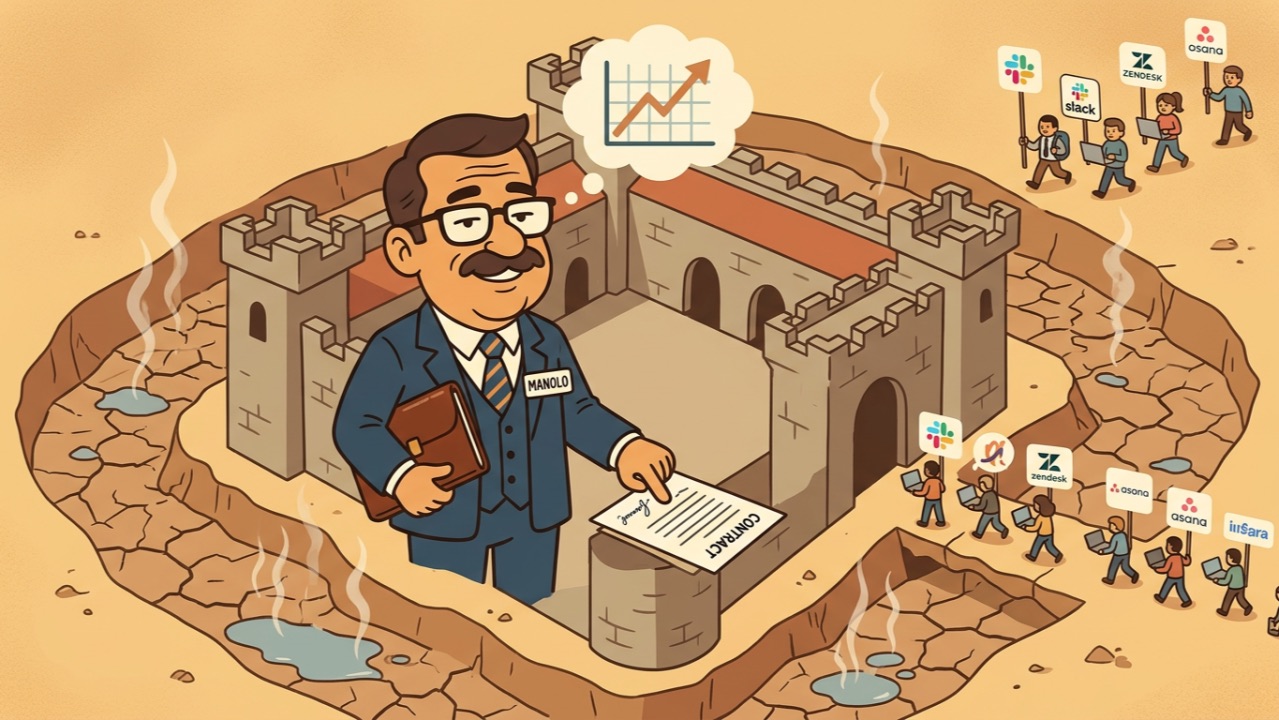
(or why your exclusive contracts are ice in a desert)
Tuesday. 09:15. Manolo walks in with a landowner's stride. Leather folder. New tie. And that expression of a man who has just renewed an exclusivity contract for three more years.
—Jose, locked in. Three more years with the big four.
—Same terms?
—Better. We've raised prices 8%.
—And what did they ask for in return?
—Nothing special. More reporting, some new dashboard. The usual.
I look at him. Manolo has just described, without knowing it, the exact symptom of an evaporating moat: the client pays more but asks for less. That's not loyalty. It's inertia. And inertia, in dynamic systems, is not a force. It's the absence of forces.
Rudolf Clausius formulated the second law of thermodynamics in 1865: in a closed system, entropy always increases. Disorder grows. Useful energy degrades. And no natural process spontaneously reverses that.
Manolo has a closed system: four big clients, long contracts, little portfolio renewal, zero exposure to the open market. His moat isn't deep. It's stagnant. And stagnant water doesn't protect castles — it rots them.
—But Jose, we've had these clients for twelve years. Twelve. That's trust.
—No, Manolo. That's switching cost. And switching cost is the most dangerous moat there is, because it gets mistaken for loyalty until the day it disappears.
Michael Porter drew the distinction with surgical precision: switching cost is a barrier, not a relationship. It protects as long as it stays high. But with every passing year, technology lowers it, alternatives erode it, and a hungry competitor wipes it out by offering free migration.
Manolo doesn't see it because he isn't looking at the whole game. He's looking at his own square.
John Nash proved that in a repeated game, cooperation holds only while both players perceive that the future has enough value not to defect. It's the shadow of the future. Your client cooperates today because they believe you'll still be useful to them tomorrow.
But what happens when that shadow shortens?
When a new competitor offers 80% of your product at a third of the price. When AI turns your "personalized service" into a commodity. When your client hires a 32-year-old head of procurement who doesn't know you, owes you nothing, and only reads dashboards.
The shadow of the future shrinks. And with it, the incentive to cooperate.
—Jose, but we have lock-in clauses.
—Manolo, a lock-in clause is not a moat. It's a fine. And fines only work when they cost more than the alternative.
There lies the thermodynamic trap of the exclusive contract: Manolo believes he has built a stable system. But what he has built is an isolated system. And the second law is merciless with isolated systems: maximum entropy is inevitable. It's only a matter of time.
In an open system you can import fresh energy: new clients, new markets, new value propositions. Entropy is offset with flow. With renewal. With creative friction.
But Manolo has optimized to avoid friction. He has eliminated uncertainty. He has built a business where everything is predictable.
And the predictable, in thermodynamics, has a name: thermal equilibrium. Temperature evens out everywhere. No more gradient. No more energy flow. No more useful work possible.
Heat death.
—Jose, but our NPS is at 78.
—How many of those clients have referred you to anyone in the past year?
Silence.
—How many have expanded their scope with you?
More silence.
—How many have called you to ask for something that wasn't in the contract?
Total silence.
An NPS of 78 with no referrals, no expansion and no spontaneous demand isn't satisfaction. It's absence of complaint. And absence of complaint in a closed system is the waiting room of silent replacement.
Robert Axelrod proved it in his iterated prisoner's dilemma tournaments: the winning strategy, tit-for-tat, works because it responds. It cooperates when the other cooperates, punishes when the other defects. But to respond, you need information. You need to see the other player's move.
Manolo doesn't have information. He has reporting. He has dashboards. He has KPIs he himself defined so they'd come out looking good.
He doesn't know what his clients are evaluating. He doesn't know who they're talking to. He doesn't know what demos they've seen. He doesn't know which budgets are being quietly redistributed.
His repeated game has become a game of incomplete information. And in game theory, when you lose information, you lose the ability to respond. And when you lose the ability to respond, you lose the game.
—Jose, so what do you propose? That I break my own contracts?
—No, Manolo. I propose you stop confusing the contract with the value. The contract is the frame. The value is what you put inside it every quarter. And if what you put inside is the same as three years ago, your client isn't buying value. They're paying out of habit.
Ludwig Boltzmann defined entropy as a measure of the number of microstates compatible with a given macrostate. Translated to business: the more ways your client has to solve their problem without you, the higher the entropy of your competitive position. Even if the macrostate —the signed contract— stays the same.
Manolo sees the macrostate: contract in force, invoice collected, renewal closed.
He doesn't see the microstates multiplying: a SaaS competitor charging per use, an internal team already doing half of what Manolo bills for, an AI automating the reporting that justified 40% of the fee.
The contract is still there. The moat isn't.
—Manolo, do you know the difference between a moat with water and a dry moat?
—What is it?
—A dry moat looks like a moat until someone tries to cross it and discovers they can just walk.
Your clients haven't tried to cross yet. But the water is evaporating. And you, instead of looking for new springs, are celebrating that the moat is still there.
The second law doesn't negotiate, Manolo. There is no lock-in clause against entropy. There is no renewal that reverses thermodynamics.
Either you import new energy into the system —real, differential, unpredictable value— or thermal equilibrium will come.
And when it comes, there will be no noise. No complaint. No negative NPS.
Just a polite email on a Friday afternoon: "We have decided to explore other options for the next cycle."
No drama. No conflict. No heat.
Perfect heat death.
Thanks for reading.