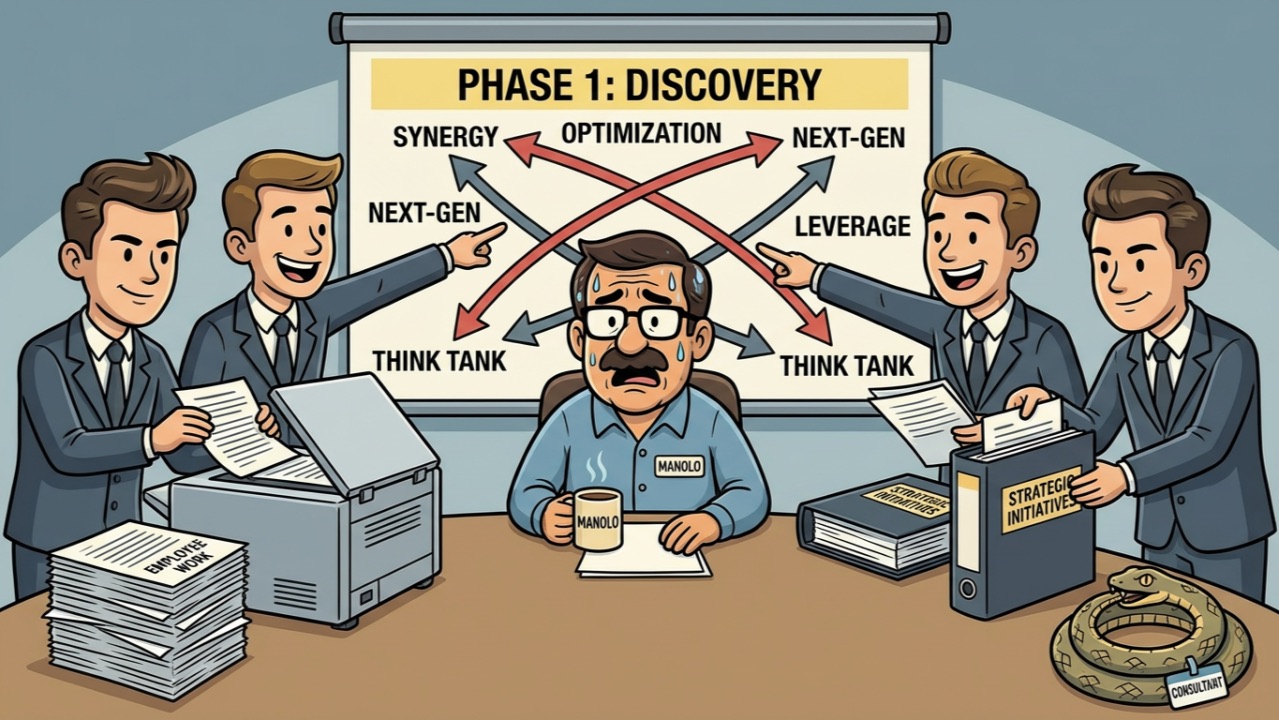
Tuesday. 09:07. My office door opens with a solemnity that scares the hell out of me. Manolo walks in accompanied. I repeat: ac-com-pa-nied. Two people I don't know. Suits. Catalog smiles. Corporate folder. The air smells of consulting
—Jose, meet María and Iñaki. From Mc-eggs
—Pleasure. And who are you?
—We're the Discovery team Manuel has engaged.
(Manuel. They called Manolo MA-NU-EL. I'm doubling my bet.)
Discovery. The word that turns "we're going to ask you things you already know" into a six-figure invoice.
—Manolo, can we talk alone for a minute?
The consultants wait outside with the zen patience of people who bill by the hour. I close the door.
—What have you done?
—I've hired a consulting firm. For the digital transformation.
—Manolo. We've been doing digital transformation for three years.
—Sure, but now it'll be done with methodology.
Methodology. The favorite word of the executive who doesn't know what to do but needs to look like he's doing something. The consulting firm as corporate Orfidal.
—All right, show me what they've sold you.
He opens the folder.
Slide 1: big logo, inspirational line along the lines of "Unlocking your digital potential".
Slide 2: a diagram with so many arrows it looks like the Tokyo subway map.
Slide 3: "Nuestro approach".
—Approach? Manolo, this is Castellón, not Silicon Valley.
—Well, they work in English.
—They bill in euros, I hope.
He walks me through the plan.
Phase 1: Discovery. Three months. Four consultants interviewing the whole team to "map the current state". Translation: they're going to ask your people what problems they have. Your people, who have spent two years telling you. But since you ignored them because they didn't have a PowerPoint with gradients, now these folks show up, ask them exactly the same thing, pour it into a pretty template, and suddenly it's true. Because of course, at 3,000 euros a day, the truth sounds better.
—Then comes Phase 2 —says Manolo, excited.
—Let me guess. Assessment.
—Yes! How did you know?
—Because there's always an Assessment, Manolo…
It's like the second act of a bad movie. You take what the team told you in Discovery, change the typeface, label it "findings" and "recommendations", and present it in a two-hour meeting with coffee and pastries. The findings, curiously, always include the need for a Phase 3.
—Well, Phase 3 is the Strategic Roadmap.
—The Roadmap. 120 pages. 18 months. That nobody will read and nobody will follow. But it looks great bound on the board's bookshelf.
—Jose, why are you like this?
—Because I've spent 20 years watching the same movie, Manolo. Do you know what an ouroboros is?
—A Pokémon?
—It's the snake that eats its own tail. And it's exactly what you've just bought. The consultants come in, discover what you already knew, sell it back to you as new, charge you to implement what your own team could have done, and when it doesn't work… do you know what happens?
—What?
—You need another consulting firm to fix what the first one did. The perfect ouroboros.
He squirms. It stings. Goooooooood.
—But Jose, these people have experience with big companies. They've worked with banks, telcos, insurers…
—Exactly. And do you know who works on those projects? The juniors. María and Iñaki waiting out there have been at the firm for eighteen months. They get paid 28,000 a year and get billed to you at 600 a day. Do the math. And in six months they'll be rotated to another client, right when they start understanding your business. And another junior arrives who needs another three months to catch up.
It's the perfect model: the worse they do it, the more time they need. The more time they need, the more they bill.
—But the partners…
—The partners are what they show you during the sale. They come to the kick-off. And then you don't see them again until the final presentation. It's like signing Messi and having the under-18 B team play.
Manolo looks at the folder. Those beautiful slides. Those professional gradients.
—And what about the big firms?
—McKylian is brilliant at what it does: telling a CEO what the CEO wants to hear, with data to back it up. Do you know how many of the great corporate disasters of the last 20 years had a big consulting firm behind them? Enron. Swissair.
Kodak's restructuring…
It's not that they're bad.
It's that the consulting business model isn't aligned with your success. It's aligned with their billing. Goodhart again: when the firm's goal is to bill hours, they will optimize for billing hours. Not for making you better.
—So what do I do? Never ask for outside help?
—I didn't say that. I said don't ask for it like this.
I tell him what should be obvious but never is:
When you have a real problem, you need someone who knows more than you about something specific. Not a firm that knows a little about everything and a lot about nothing. You need a guy or a gal with 20 years of scars who comes in, looks around, tells you the truth even if it hurts, and leaves.
Someone who tells you in two weeks what the consulting firm takes three months to discover.
No Phase 1, no Discovery, no Assessment. Because they do the assessment by looking you in the face and asking you the questions you don't want to hear.
—And if they're wrong?
—If they're wrong, you lose two weeks and a few thousand euros. If the consulting firm is wrong, you lose a year and half a million. Which do you prefer?
—But the consulting firm gives me a deliverable.
—Manolo, the deliverable is a PDF you're going to shove in a drawer. You know it. I know it. They know it. But we all pretend the PDF has value because that way the board sees that "something has been done".
The real deliverable isn't the document.
It's your company working better.
And that doesn't come out of a PowerPoint. It comes out of hard decisions made by people who understand your business. Which is your team. The one you haven't listened to in two years.
A long silence. The heavy kind.
—Jose… I've already signed the contract.
—I know, Manolo. I know.
—Now what?
—Now you do what everyone does. You let them run the Discovery. You ignore 80% of the report. You implement the two or three things your team had already asked you for. And a year from now you tell the board that "the consultants helped us transform". Everyone's happy. Nobody has learned anything. But there's a pretty PowerPoint to prove it.
He gets up.
Slowly.
With the corporate folder under his arm and the face of a man who has just discovered that the 200-euro tasting menu was all foam.
He opens the door. María and Iñaki are still there, with their laptops and their kick-off smiles.
They've already billed one hour each.
—Come in, come in —Manolo tells them—. Shall we start with the Discovery?
And from my chair, I watch the snake start biting its own tail. Again.
Ten minutes later I get an email from the consulting firm.
They're inviting me to a "strategic alignment kick-off workshop".
Four hours. Post-its included.
I want to die.
And I, after 20 years in this business, know exactly where those post-its are going to end up.
> There are good consulting firms. There are. They're the ones that tell you what you don't want to hear, not the ones that charge you for telling you what you already know with better formatting.
Next time someone sells you an "end-to-end transformation", ask them one thing: how much do you charge to leave? Because a consultant's true success is you no longer needing them. And that, curiously, runs against their model.
Thanks for reading.