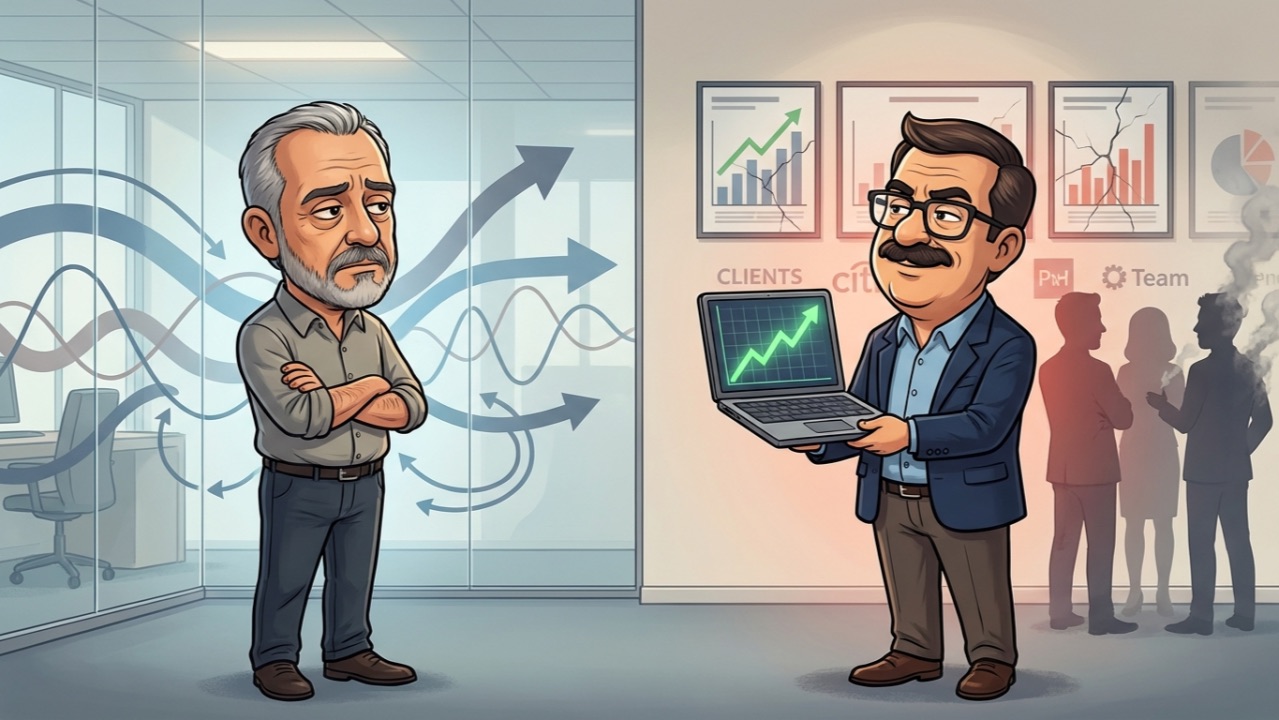
(or how to make money while destroying the system)
Monday. 09:00. Manolo walks in with that dangerous smile of a man who believes he has beaten physics. Coffee in one hand. Excel in the other. And a speech learned by heart.
—Man, EBITDA just keeps climbing.
—And the clients?
—Fewer, but more profitable.
—And the team?
—Leaner.
—And the product? —More efficient.
I look at him in silence.
Katsuhiko Ogata would call it a critically damped oscillation: the system no longer vibrates, but it can no longer correct itself either. It looks stable… precisely because it has lost degrees of freedom.
Manolo has built a company that looks healthy. Quarter after quarter the numbers go up. The spreadsheet smiles. The board applauds.
Everything fits together a little too well.
And when everything fits together too well, it's usually because nothing is being learned anymore.
The senior people leave without making a sound. Clients stop recommending you. The product no longer surprises: it only optimizes. And the most important curve -the learning curve- flattens until it disappears.
But none of that shows up in the PowerPoint. That arrives late. It always arrives late.
Ogata explained it with equations Manolo will never read: a system with high gain and delayed feedback can look stable for years… until it collapses irreversibly.
That is exactly what Manolo is doing: turning up the gain (more pressure on margin), removing damping (fewer people who question), and delaying real feedback (less client contact, more reporting).
—Jose, we've been growing for three years —he tells me, proud.
—Yes, Manolo. And a stalling plane is still climbing one second before impact.
Jay Forrester called it systemic delay: when the punishment arrives exactly when you can no longer change anything. The market doesn't warn you when you start wrecking the system. It warns you when it's already too late.
But Manolo reads the system's output —EBITDA— as proof of health. He doesn't see that it's a delayed signal. A photo of the past, not the future.
So he keeps squeezing.
Less support. Less talent. More processes. More reporting. More efficiency.
Until the system stops oscillating. Not because it's under control. But because it no longer has any capacity to respond.
The day everything breaks, Manolo calls it “strategic restructuring.” Never “having arrived too late.”
W. Edwards Deming said it without anesthesia: when you manage by financial results alone, you're steering while looking in the rearview mirror.
—Jose, but right now everything works.
—Exactly, Manolo. That's what makes this moment dangerous.
In control theory, the most stable point is also the most fragile one if you've removed the damping. No noise. No alarm. No oscillation.
Just silence.
And silence, in living systems, is not health. It's heat death.
Value isn't destroyed all at once. It evaporates slowly, quarter after quarter, while the spreadsheet keeps smiling.
A system without feedback or damping doesn't break: it becomes irrelevant without making a sound.
And when the market finally responds, the response arrives so late that no correction is possible anymore.
So, Manolo, before celebrating another “historic” year, remember this:
> Money is a delayed signal of value. If money is all you listen to, you will always arrive late.
Ogata left it in writing years ago: a system can look perfectly controlled… right before losing control completely.
Gradually, then suddenly.
And at that point, Manolo, no spreadsheet will save you.
Thanks for reading.