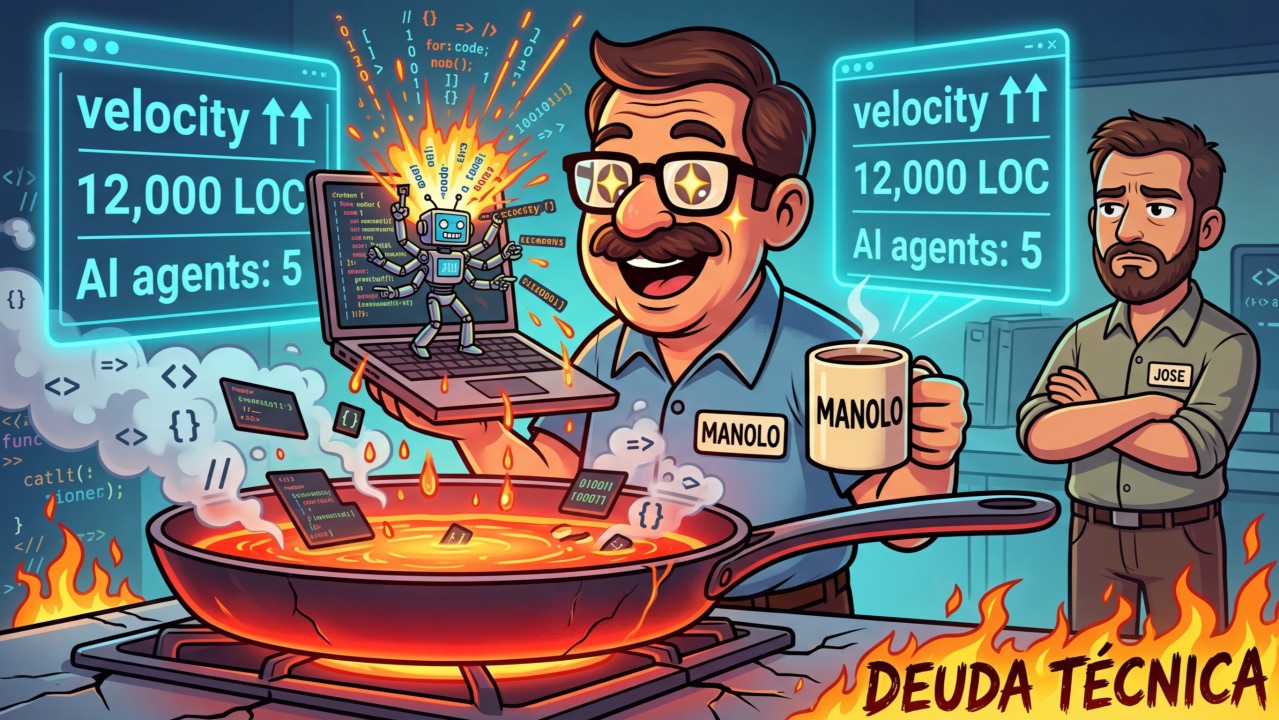
(or why generating more code doesn't make you more productive)
Tuesday. 09:02. Manolo walks in beaming. Laptop open in his hands. On the screen, an AI agent writing code by itself. Lines popping up like popcorn in a microwave.
—Jose, look at this. In twenty minutes it has generated what takes your team two sprints.
—Have you read it?
—What for? It works.
—Have you tested it?
—It compiles.
—Compiling isn't working, Manolo.
But Manolo has stopped listening. Manolo has discovered vibe coding. And like every recent convert, he comes with the faith of a man who hasn't been burned yet.
What Manolo doesn't know is that he's about to live through the Leidenfrost effect.
In 1756, Johann Gottlob Leidenfrost described something counterintuitive: when a drop of water falls on a very hot surface, it doesn't evaporate immediately. It forms a layer of vapor underneath that insulates it. The drop levitates. It dances. It survives longer than it should.
More heat, less evaporation.
Sounds absurd. It's physics.
The exact same thing happens with code generation.
At first, AI speeds everything up. Autocomplete, boilerplate, plumbing functions. The contact between the developer and the problem is direct. The heat transfer works. Productivity genuinely rises.
But Manolo doesn't want a little AI. Manolo wants all the AI. Autonomous agents. Zero human intervention. Code that writes itself while he's on a podcast talking about innovation.
And that's where the vapor layer forms.
The team stops touching the code. Stops understanding it. Stops having cognitive contact with what's being built. Code gets generated at spectacular speed, but nobody really knows what it does, why it does it that way, or what will happen when it fails.
And it always fails.
—Manolo, how many lines has your agent generated this week?
—Twelve thousand.
—And how many does your team understand?
Silence.
—How many have you reviewed yourself?
More silence.
—Manolo, that's not speed. That's technical debt at compound interest.
But the dashboards say otherwise. The dashboards say velocity has tripled. That throughput is at an all-time high. That story points are flying.
And Manolo confuses generation speed with value-delivery speed. Just as someone might confuse temperature with evaporation rate.
The Leidenfrost point of generated code is that threshold where the amount of code exceeds the human team's capacity to stay in contact with it. From there on:
Debugging becomes archaeology of someone else's code. Code reviews are theater: what isn't understood gets approved. Technical debt piles up invisibly because nobody understands the decisions the model made. And one day, something breaks. And nobody knows why. Or where. Or how to fix it without generating three new bugs.
—Jose, but the agent can fix its own bugs.
—Manolo, a system that generates bugs and then fixes them isn't productive. It's a dog chasing its own tail at GPU speed.
Frederick Brooks warned about it in 1975: there is no silver bullet. Adding more generation capacity doesn't solve the essential complexity of software. It only hides it. And the more you hide it, the bigger the explosion when it surfaces.
The real art isn't generating more code. It's staying just short of the Leidenfrost point. Using AI to accelerate without losing direct contact with the problem. Keeping the team understanding what it builds. Keeping the architectural decisions human, not statistical.
Or, and this is the radical bet: accepting that code is a disposable intermediate artifact. That the thermal contact is no longer between human and code, but between human and intent. But that requires verification and testing tools that still have to be built.
And Manolo isn't going to wait for them to exist.
—Jose, I've put four more agents on the project.
—Manolo, do you remember your mother's frying pan?
—What does that have to do with anything?
—When it was warm, the drop of water evaporated instantly. When it was red-hot, the drop danced for thirty seconds without disappearing.
—So?
—So you've just turned the pan red-hot and you think you're cooking faster.
Manolo blinks.
—You're floating on your own vapor, Manolo. And when it dissipates, you're going to get burned.
But Manolo is already gone. He has a demo with investors at eleven.
He's going to show them the frying pan.
Thanks for reading.
Onward.