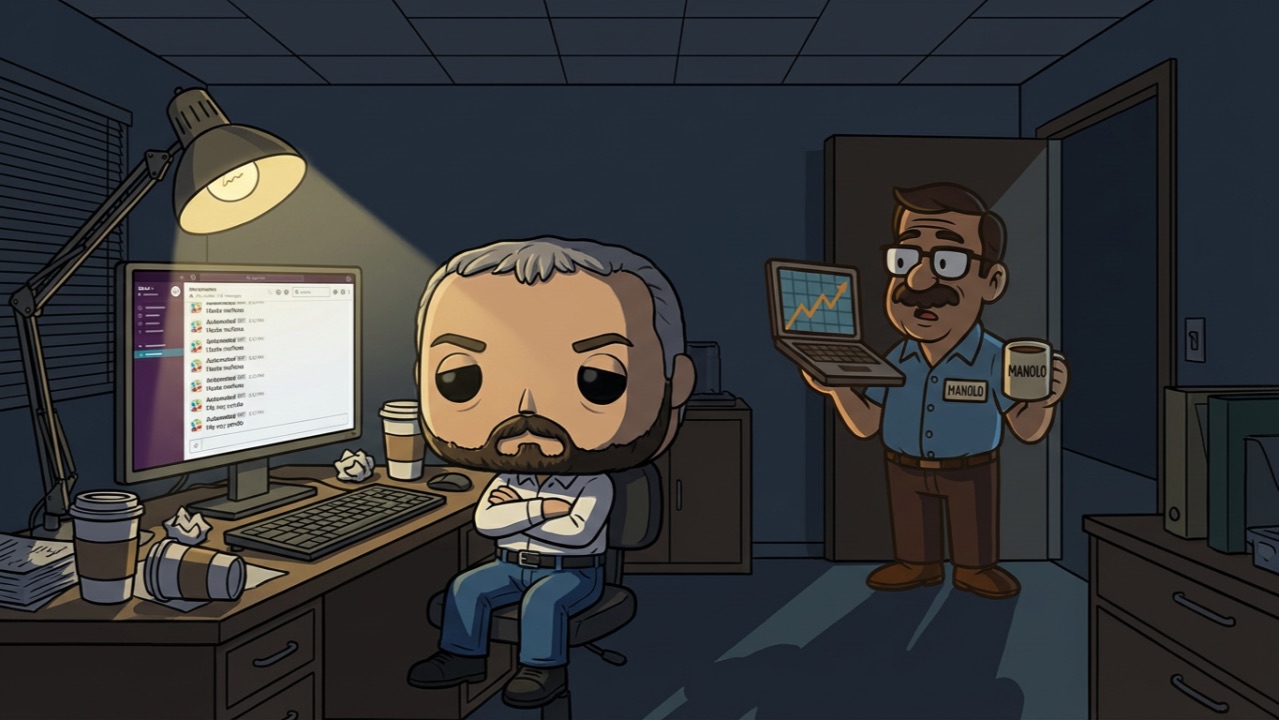
Tuesday, December 23rd. 18:42. The office is half dark. Not because I enjoy the drama, but because there's nobody left in the building and the smart lighting system decides for me.
Outside it smells like holidays. Inside, like a badly digested year-end close.
I'm reviewing, for the fifth time, a document nobody will read before January when the door opens without a knock. Manolo walks in with his laptop open, with coffee, and with a worried face...
The worst possible combination.
—Jose —he says—, I've spent weeks chewing on what you say about living systems, continuous learning, infinite games... He pauses. —And I'm not quite buying it.
He sits down without waiting for permission. That alone tells me he's come loaded.
—In big companies this doesn't happen, Jose.
—What doesn't?
—The chaos. Over there they have processes, dates, committees, certainties. Things flow.
There it is. The myth of big companies.
I smile, but wearily.
—Manolo... do you know why everything "flows" in December?
—Because they plan well.
—No. Because nobody wants an argument before Christmas Eve.
Silence.
—Big companies don't have more certainties —I continue—. They have more layers to hide the uncertainty.
I explain slowly, because today I don't have the energy for quick irony.
—What you call "flow" is structural delay. Forrester explained it in the sixties: the bigger the system, the longer it takes to react. Not because it's better, but because it's anesthetized. Just ask Apple...
Manolo frowns.
—But they have three-year roadmaps. —Sure. And they also have roadmap graveyards.
I tell him something that rarely shows up in the PowerPoints: in big companies, deadlines don't disappear, they get negotiated until they lose all meaning.
The date is met. It doesn't matter whether the product is any good. What matters is that someone can say "we made it."
—That's not flowing, Manolo. That's inertia with a lot of cash on hand.
He closes the laptop, a sign that this conversation is going to run long.
—So it's all smoke and mirrors?
—No. It's organizational thermodynamics.
I explain that big systems look stable because they dissipate errors slowly. Small ones feel them fast. That's why in a startup the failure hurts today, and in a corporation it explodes years later... when there's nobody responsible left.
Donella Meadows says something like: "Complex systems don't fail when you push them, they fail when you ignore their delays."
—Okay —Manolo says—, but I need certainties to manage.
—No. You need judgment to decide without them, Manolo.
And there's the point that always hurts.
—Mature companies aren't the ones with the most control. They're the ones that know what they can't control and don't kid themselves about it.
I give him a simple example, the kind that doesn't feel like theory:
—When a multinational launches something "on time," it's almost always because it cut scope, hid risks, or shifted the problem onto support, operations, or the customer. That's not execution. It's an entropy hand-off.
Manolo laughs, but uncomfortably.
—So... everything they measure is a lie? —No. It's partial. And the partial, when presented as the whole truth, is dangerous. Remember the Indian fable of "the blind men and the elephant."
James Carse talked about finite and infinite games. Big companies play not to lose this quarter. The product at your small company plays to still be relevant next year. Confusing those games is how good products get killed by excellent committees.
I look at the clock. 18:58. Tomorrow is Christmas Eve and nobody is closing this conversation today.
—Do you know what happens in December, Manolo?
—What?
—Certainties go up because critical thinking goes down. Everybody wants to close out the year in peace.
He gets up slowly.
—So... what do I do when they ask me for deadlines "like the big companies have"?
—Give them deadlines. But explain that they're hypotheses, not promises. And that the price of faking certainty today... gets paid with interest later. Try to move in the golden zone, between reality, the plan, and the learnings.
The golden zone to move in
Before leaving, he turns around.
—Dude... at the end of the day, your thing is uncomfortable.
—I know. Comfort is for company dinners. Survival is something else.
—Merry Christmas, Jose.
—Merry Christmas, Manolo. And remember that in 2026 we have to keep playing...
He closes the door. I'm left alone, with the slanted office light and that very end-of-year feeling: that the hard part isn't managing complex systems... it's accepting that nobody has the control they claim to have.
Big companies don't live without uncertainty. They live better at hiding it.
Companies don't need certainties, because they can't have them. They need intellectual honesty, learning speed, and adults in charge.
Manolo and I wish you a merry Christmas.