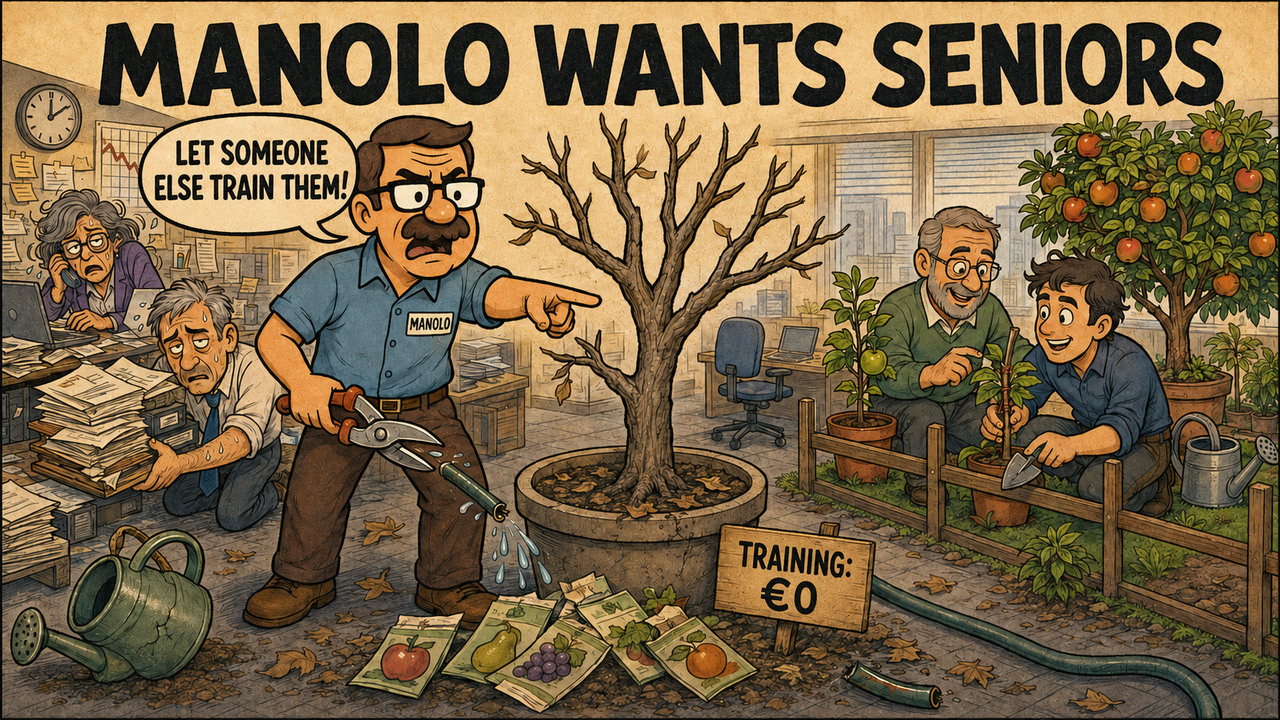
Tuesday. 09:12. Manolo has spent twenty minutes explaining to HR that this country has no talent. I can hear him from the corridor. So can the HR manager sitting opposite him, although at this volume she could be in another county.
—Jose, thank God. You tell her. Four months to hire a senior. Four.
—What are you looking for?
—Someone independent. Knows the industry, talks to clients, understands the business, can manage two people. And knows AI, obviously.
—What about the two people?
—We haven't hired them yet. We need the senior first.
On the desk is a budget with three lines crossed out. Two junior positions and a training allocation. Underneath, in green, Manolo has written “EFFICIENCY”.
—What's this?
—September budget. We had to make cuts. Juniors don't pay off anymore. AI does what they used to do.
—Who's going to learn, then?
—We need people who already know the job.
—Where do they learn it?
—At other companies, Jose. I didn't invent the labour market.
The HR manager looks out of the window. Some people can resign without leaving their chair.
—Manolo, were you born knowing how to handle an angry client?
—I figured things out for myself.
—On your own?
—Well. There was Paco.
—What did Paco do?
—Took me to client meetings. Afterwards, in the car, he'd explain where I'd screwed up.
—Did you screw up?
—Constantly. Once I promised a deadline that nearly cost us the account.
—What did Paco do?
—Called the client. Sorted it out. Then spent two hours explaining why you never promise a date without talking to Operations first.
—How inefficient of Paco. Two hours. He could have hired someone who already knew.
Manolo puts down his pen.
—Different times.
—Yes. Back then someone taught you, and afterwards you said you were self-made. Now you want to cut out the teaching altogether.
He shows me a job advert. Five years' experience, commercial judgment, technical autonomy, leadership skills and a “continuous learning mindset”.
—Continuous learning —I read—. When?
—What do you mean, when?
—You've cut training. Your seniors are swamped. You don't want juniors. When does anyone learn here?
—People who are motivated learn in their own time.
—Put that in the advert. “We want someone to pay for the skills we need to make money, out of their own pocket and in their spare time.” Bit long for LinkedIn, but pretty fucking clear.
—We can't be a school.
I open my laptop.
—Look at this. Google lists today, September 8, as the opening date for applications to a US data analytics apprenticeship starting in February 2027. Training and work within a team. The role includes using AI tools.
—Well, Google can afford it.
—And you can afford to leave a role vacant for four months, pay recruitment fees and have Laura do three people's jobs. Somehow the thing you can't afford is two hours of teaching.
The Google listing doesn't prove every company should hire apprentices or guarantee a job at the end. It's one programme in one country. But there it is: learning a profession and learning to use AI, in the same job description.
Manolo had decided one made the other unnecessary.
—Jose, a junior used to prepare an analysis. Now a machine does it in two minutes.
—Fine. Who decides whether it answers the client's question?
—The senior.
—How did the senior learn?
—By doing analyses, I suppose.
—And finding out which ones were wrong. Explaining them. Hearing a client say, “This isn't what I asked for.” If you automate that task, you'll need another way to teach those things. The licence doesn't design the learning for you.
I don't miss making a young employee spend three days copying spreadsheet cells. If a tool takes that work away, great. But reviewing a result with someone experienced, defending a decision and discovering an exception still have value. You have to build that learning path. Otherwise, in five years we'll demand judgment from people we aren't letting practise it today.
Manolo's phone rings. Laura.
—Yes… Right… No, tomorrow's impossible. Can't someone else deal with it?
He listens.
—Right. We'll talk later.
He puts the phone face down.
—What's happened?
—She needs to take her father to hospital. And we've got the Bilbao client tomorrow.
—Who else knows that account?
—She's the one who knows it.
—Who's learning from her?
—Nobody right now. I told you, she's swamped.
There's the real budget. Two positions crossed out in green. One person who can't take a day off. And Manolo convinced he's just reduced a cost.
—You had Nuria working with her last quarter.
—Internship. It ended. She was good, but she asked a lot of questions.
—Like what?
—Why we invoice Bilbao differently. Why we don't use the new rates. Things like that.
—Exactly the things only Laura knows today.
He stares at his phone.
—I'm not putting a junior in front of that client.
—Not alone. With Laura. First she listens. Then she prepares one part. Laura reviews it. Then she explains it herself. Once she understands the exceptions, she handles a limited case. That's how someone starts being able to cover for Laura for a morning.
—That takes up Laura's time.
—Yes. Put it in the plan. Take something else off her plate. If you keep all her targets and add training Nuria, you've created two jobs on one salary.
—How long before Nuria can work independently?
—On what task? Preparing a reconciliation isn't renegotiating the contract. Decide what she should be able to do in a month, who will review it and what kind of mistake you can afford. Start there.
Manolo picks up his pen again. This time he turns the page over.
—What if I train her and she leaves?
—She might.
—Some investment that is.
—The senior you're trying to hire might leave too. In fact, your entire plan depends on them leaving somewhere else.
The HR manager returns from the window. Without having stood up.
—We've spent the whole morning preparing an offer to persuade someone to leave the company that trained them —she says—. And you find it intolerable that the same thing might happen here.
Manolo doesn't answer straight away.
—Is Nuria still looking?
—I can ask. But first I need to know who will teach her and what we're removing from Laura's schedule.
—The board presentation…
—You'll update it —she says.
Manolo looks at me. Checking whether he can appeal.
He can't.
They leave to talk to Laura. The senior job advert stays on the desk. They still need that person. Training Nuria won't make her the account lead by Thursday. The problem is, last September they couldn't make a start either. Or the September before that.
I think of Paco, driving back from that disastrous client meeting. Two hours explaining to a young man why he'd messed up. He probably had other things to do.
Some of the judgment Manolo has spent years taking credit for came out of those two hours.
Now it's his turn to decide whether to give something back.
Because Manolo wants the harvest.
Planting looks like an expense.
Thanks for reading.
We all know a Manolo. Sometimes we are the Manolo. A new one every Tuesday.