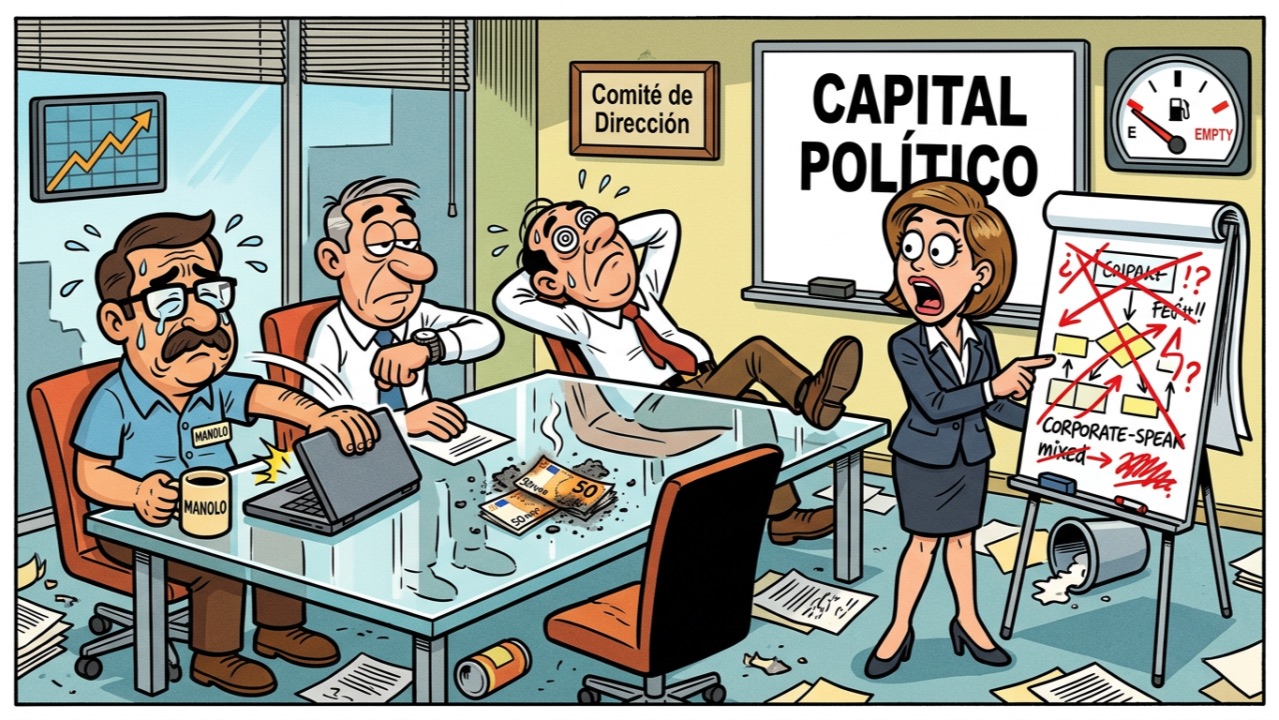
Wednesday. 10:14. Executive committee. Glass-walled room, mediocre coffee, laptops open like shields.
Marta, from operations, presents a proposal to reorganize the support team. It's not perfect. It has a couple of weak metrics and a dependency she hasn't accounted for. But the direction is good, the team backs it, and it solves a real problem we've been dragging around for two quarters.
The CEO nods. Finance doesn't object. Product sees the fit.
And then Manolo speaks.
—Sorry, Marta, but the framework you're using mixes concepts. This isn't a RACI, it's a mislabeled DACI. And the resolution KPI you're proposing doesn't distinguish between first response and full resolution. Those are different things.
Silence. The kind that smells like a funeral.
Marta blinks. Not because Manolo is wrong —technically he's right— but because he has just stopped a proposal that was about to be approved in order to deliver a master class nobody asked for. Like the guy who interrupts a wedding toast to correct the pronunciation of the wine.
The CEO checks his watch. Finance closes the laptop. Marta's proposal is postponed "for review."
Manolo leaves the committee satisfied. He has shown that he knows. He has brought rigor where there was ambiguity.
I wait for him in the hallway.
—Manolo, come here a second.
—Did you see that? Good thing I was there. That was about to get approved with the concepts all mixed up.
—Yes, Manolo. And now nothing is going to get approved. Marta will spend two weeks redoing something that worked. The support team still isn't reorganized. And you have achieved exactly… what?
—That it gets done right.
—No. That it doesn't get done.
He goes quiet. But not convinced. Manolo quiet and unconvinced is like a volcano on pause: you know it's coming back.
—Manolo, do you know what political capital is?
—Sounds like bureaucracy.
—It's the opposite. It's the finite amount of credibility, influence and attention you have in an organization. Every time you open your mouth in a committee, you spend a little. It regenerates slowly —with results, with good calls, with trust— and it burns fast. Very fast.
—I have credibility to spare.
—You had. Today you burned a fifty-euro note to light a cigarette.
He doesn't like the metaphor. Good.
Jeffrey Pfeffer has spent decades teaching this at Stanford and lays it out in Power: organizational power isn't something you have, it's something you manage. Every intervention has a cost and a return. Those who understand this pick their battles. Those who don't die of a thousand small corrections nobody remembers.
—But if Marta had it wrong…
—Marta had it good enough. And "good enough" approved is worth infinitely more than "perfect" postponed. Voltaire said that, and he wasn't exactly a product guy, but he already warned us: perfect is the enemy of good.
—So I never correct anything?
—You correct when it changes a decision. Not when it only proves you know more.
The rule is simple, Manolo. Before opening your mouth in a committee, ask yourself: does this change the outcome, or does it only change what the others think of me? If it's the latter, it's pure expense. Bob Sutton, also at Stanford, distills it in The No Asshole Rule without calling it that: the public correction that changes nothing only changes how people see you. And not for the better.
—But if I don't say it, nobody says it.
—Because nobody needs it said, Manolo. That's the part you don't see. Not every imprecision deserves a public correction. Sometimes silence is the smartest move you can make in a room.
—Jose, I just want things done right.
—I know. But there's a difference between putting a verified number where there was a hunch —that builds capital— and correcting a label nobody cares about —that burns it—. The first makes you indispensable. The second makes you insufferable. And the line between the two is thinner than you think.
Long silence.
—And Marta?
—Marta now has a problem she didn't have before walking into that room. And you have a political capital bill you can't refund.
He leaves. Slowly. No notebook. No expensive pen.
And I'm left thinking that Manolo will probably show up at the next committee, spot another imprecision, and correct it again.
Because political capital is like health: you only realize it existed when you have none left.
Thanks for reading.