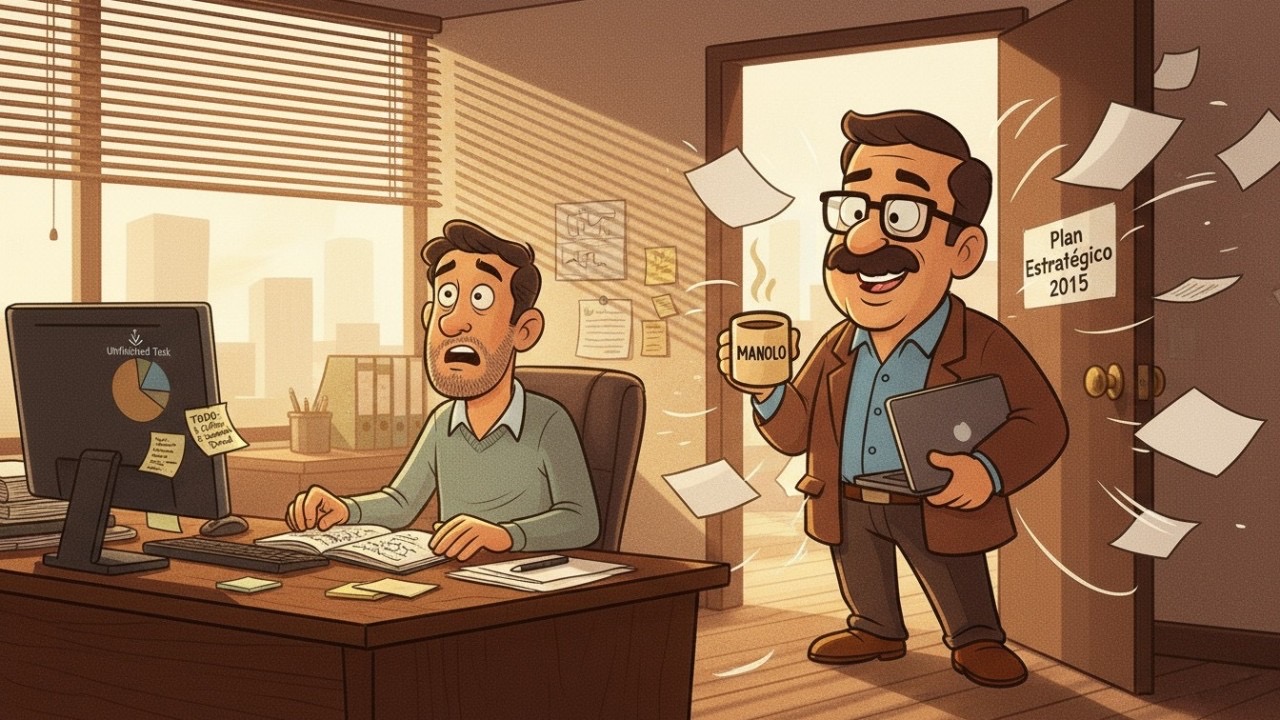
Monday. 09:00. My office door opens like a scene from Poltergeist. I nearly jump out of my skin. I look up from my notebook, where I was jotting down the two things I was absolutely going to finish today. And there he is. Manolo.
No knocking. Coffee in hand. And a face that says "today you're really going to freak out, Jose".
—Man —he says, planting himself in front of me—, we're going to bring in more people to make more flavors for the soft-drink line. It worked for us ten years ago. We've always done it this way, and expanding the flavor mix has served us well.
I need to scale the company to meet the commitments we have with the VC.
—Silence. The kind that lasts two seconds but feels like two hours—
—Do you want me to applaud, Manolo, or should I have them build a museum of your greatest hits on the ground floor?
—Don't start.
—Easy, I'm just saying that selling BlackBerrys also worked… until it didn't. And mind you: they also tried releasing more and more models… and the only thing they multiplied was... the confusion. In 2011, five new smartphones landed at once.
They called it BlackBerry's Model Madness!
Manolo crosses his arms. He has that face he makes when he sees I might be right, and then forgets all about it.
—Manolo… do you know the difference between 2015 and today?
—That now everybody wants more flavors.
—No, champ. That everybody ALREADY has them.
Ten years ago adding a new flavor meant standing out. Today it means walking into a shelf-space war with 30 identical bottles fighting over 10 centimeters of shelf. Back then it added differentiation. Today it adds operational complexity, more cost, more dead stock… and zero real advantage.
—But people like flavors.
—Sure, and they like TV shows too. That doesn't mean Netflix makes 500 spin-offs of every secondary character.
The market doesn't reward whoever launches the most stuff; it rewards whoever launches stuff that matters. And nobody cares about your new mango-kiwi-lime flavor. Do you know how many human beings have lived since Homo sapiens appeared?
—Man, don't start with your documentary stuff again.
—A cool 117 billion. ONE HUNDRED AND SEVENTEEN BILLION. We really do love dying, don't we?
—So?
—So 85% of all those people were born after 1800. After the steam engine. After the world started running faster than your MacBook M5 128GB
Exponential population growth since the industrial revolution
I look him dead in the eye. —Your "always" is a historical blink. With that curve combined with today's technology, fads last days and strategic plans last months...
The dangerous thing isn't when something doesn't work. The dangerous thing is when it works for so long that you start believing it always will, without ever noticing the CONTEXT.
—But for years we…
—…lived in a context that no longer exists. Congratulations, you were the BlackBerry of your niche.
What Manolo doesn't see is that past success is the most powerful narcotic there is. It numbs you. It makes you believe you're bulletproof. And by the time you wake up… someone else is selling your product better, faster, and from a country you didn't know how to pronounce.
—Man, but we've always done it this way and nothing's happened, and I need to scale to deliver for the VC people and that Series-whatever we've gotten ourselves into.
—Nothing's happened yet. That's not proof of success, Manolo. It's a countdown. And this isn't how you'll pull it off. Least of all in VUCA and BAMI environments.
—What's that?
—I'll tell you another day; right now I have to stop you from making the vomit-flavored soda because you saw it in Harry Potter.
MANOLO, grab pen and paper, and repeat each of these lines 50 times.
"It's always worked here" doesn't mean "it will work tomorrow". Ten years is a blink * "Always" is an excuse. And a bad one.
> "Manolo, instead of launching another flavor nobody asked for, try finding out why people buy (or don't buy) the one you already have"
Thanks for reading. If you enjoyed it, any repost, a WhatsApp share or a simple like will make my day. Have a good Monday.