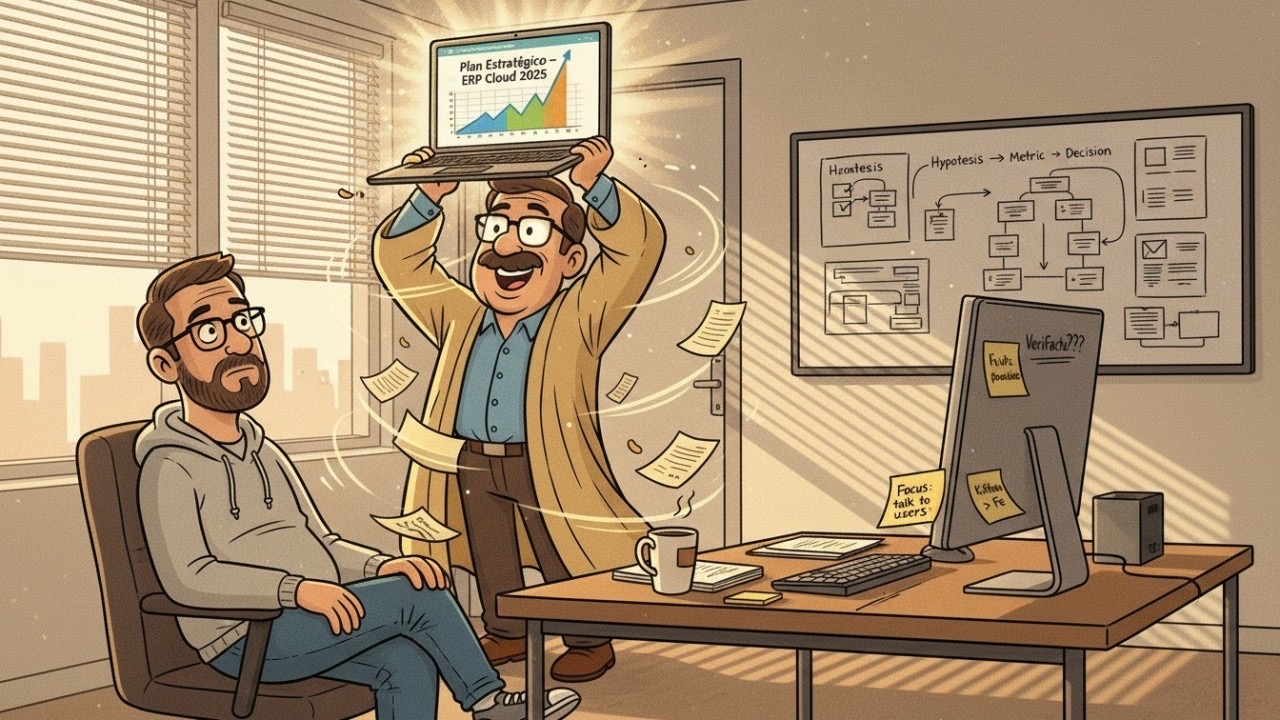
Tuesday. 09:15. My office door opens veeeery slowly. Manolo walks in slowly, lit by the glow of his laptop. He looks like Moses coming down from Mount Sinai… only instead of the tablets of the law, he's bringing me an Excel, and I'm already starting to panic.
—Man —he tells me, in the voice of someone who's just found out the Three Kings are really the parents—, I've got the new strategic plan for the consultancy.
—How many coffees have you had, Manolo?
—Three. But hear me out: this year we double revenue with the new Cloud ERP for SMEs, and we're diving headfirst into VeriFactu — that's the law now, we can't afford to be off the map, and I've got loads of improvement ideas.
Every invoice has to send its record to the state tax agency in real time, tamper-proof, with a QR code and the whole circus. I've come up with a "killer feauture" that's going to make us serious money, Jose.
We're going to crush it!
And there it is — and no, it's not the Puerta de Alcalá... it's the divine business plan...
He opens the laptop as if it were the Faraday cage where he keeps his bitcoin cold wallet. The slides roll by one after another with a narrative the screenwriter of Entrepeneur, by Alex de la Iglesia, would kill for: "Goal: five million ARR in eighteen months (we're at two)".
Then, of course, the inevitable hockey-stick chart.
Because damn, a business plan without the hockey stick looks like you're opening a deli counter, and we "is" tech people, where everything scales to infinity and beyond.
Then, "Committed team". And finally, the classic: "If we capture one percent of the market, we're rich."
A plan without a single crack.
We came here to play, damn it.
—Jose, it has scenarios: base, optimistic and very optimistic. I was going to run a Monte Carlo on it, but I don't know what that is. Couldn't find much on YouTube.
—And the realistic one?
—It didn't fit on the slide.
I start skimming through it... hmmmm.... costs drop a little, revenue skyrockets, the consultants turn water into wine and the market is anxiously waiting to buy from us. Not a trace of uncertainty, pipeline or operating margin.
—And... have you talked to a single client yet?
—No, but everyone wants to digitalize. Well, two dads from my kid's school say the plan is terrific, that now's the moment. One of them told me who invented the table — I didn't know that.
This is usually the FIRST problem. As Steve Blank used to say: there are no facts inside the building, only opinions — and the farthest Manolo has gotten outside the building is the park with the other parents.
Looking at the Excel, I see it promises two hundred percent growth with no proven channel and no active partners.
The capacity planning is flawless: nobody gets sick, nobody does pre-sales, nobody goes on vacation. In Manolo's Excel, consultants aren't people — they're billing processors with coffee in their veins. Not even AI agents will reach that level of performance, because every now and then someone will have to update the code and make the odd pull request.
The pricing is "premium" (naturally), even though there isn't one lousy case study to back it up.
The backlog is full of "proposals sent", presented as closed sales — of which there are zero. Implementations take twelve weeks because AI does everything, integrations "are easy" and migrations are handled by the junior with AI "because they already did it once".
Client adoption is summed up in a single slide titled Training & Go.
And the contracts, of course, are fixed-price with liquid scope, because "this time it definitely won't get complicated".
Nobody mentions the kill criteria — that line separating learning from ruin. In Manolo's plan, nothing can go wrong. And when everything fits together that neatly, it's usually because none of it is true.
The market doesn't buy promises, Manolo. It buys delivered projects, repeat clients and unit economics that actually sing.
Andy Grove, the man who built Intel, said it without an Excel: only the paranoid survive. And you, Manolo, are selling me peace of mind in the age of AI.
—But the partners are asking me for a plan —he says, defending his faith like a priest of the KPIs.
—They're asking you for focus, not faith.
—And the investors want the five-year vision.
—Perfect, give them the vision, but pair it with a ninety-day hypothesis that doesn't reek of PowerPoint — or worse, of Gamma app
—The bank wants projections.
—Give them projections, and give them sanity too: what you'll do if they don't come true.
The problem isn't planning, Manolo. The problem is believing the plan. Your charts aren't strategy: they're diazepam with cell formatting.
Reality doesn't fit in an Excel. Not even with macros (what a boomer I am — do people still use those?)
—So I throw out my plan, Jose?
—No, Manolo. Throw out the Excel. And while you're at it, throw out the idea that because something fits in a cell, it's going to happen — and go away for a few days to think, walk, think, walk.
Every day like that. Then think about ONE SINGLE VALUE PROPOSITION, get out on the street, talk to three clients (the ones paying us now, not the dads at the park) and come back with something that doesn't depend on "if everything goes well". That, someone will buy.
Selling ERPs isn't promising efficiency. It's proving it. And that starts with no longer making perfect plans for worlds that don't exist. The danger isn't not knowing —as Taleb says—, the danger is believing you know.
Remember Grove: only the paranoid survive.
Before you show me another hockey-stick chart, ask yourself whether you're actually planning or just hiding the complexity.
Drucker said it long ago: "There is nothing so useless as doing efficiently that which should not be done at all."
> Manolo, the market doesn't read your plans — it corrects them.
Thanks for reading.
If you truly like what I do, share it on WhatsApp or by email — don't stop at the "like"!