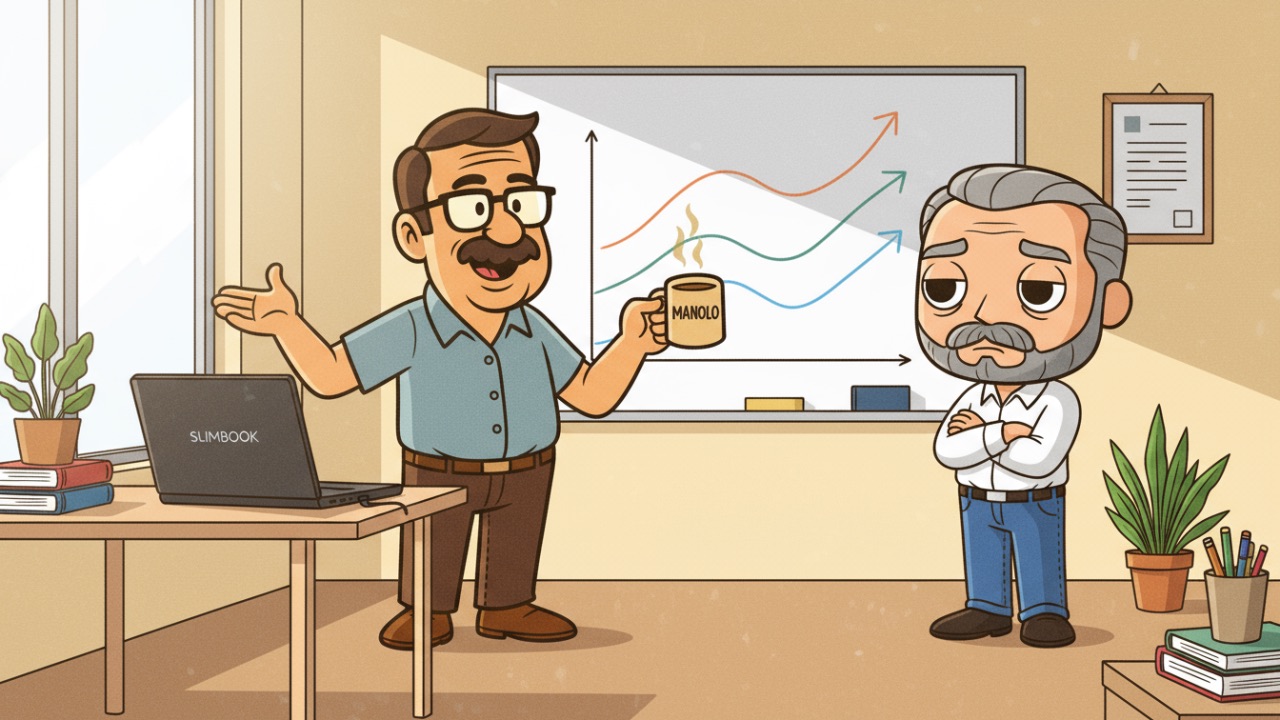
Monday, 09:05. Manolo walks into the office with that blend of faith and caffeine I know so well. He's now bought himself a flat-burr grinder that he says works better for lightly roasted coffee. Every coffee needs the right burrs to bring out its best version, and Manolo usually needs me to bring out his.
He comes in with his new SLIMBOOK under his arm and the face of a man who's discovered the formula for losing weight by eating candy.
—José —he says—, forget the hockey stick. I've found what really matters. The sigmoid curve. I went to a masterclass by some guy from LinkedIn, and now I see it all clearly....
—The growth, maturity and decline one? Did you get the talk from someone who's never lived through one but watched a talk somewhere else before you did, and then built his own masterclass on it?
—Don't start... it's more scientific. I'd already seen it in a Harvard Business Review article a few months back, but I was finishing the LinkedIn daily puzzle and then couldn't find it again.
Here's the idea, Jose.... basically we grow, we hit the plateau and, before the decline, we launch another S on top. "Sigmoid stacking", I've named it, Jose.
Infinite growth, but elegant.
—Sigmo... what?
He opens the Excel. The curve is S-shaped on its side, sure. But his goes up, up and… keeps going up. A succession of concatenated miracles with chart formatting.
—Manolo, that's not a sigmoid curve.
—No?
—No. It's like sticking a little stick on a zero... surprise... it's not a zero anymore.
I tell him about Geoffrey West, the physicist behind Scale , the Santa Fe Institute guy. How companies behave more like biological organisms than machines: they grow, stabilize and die. Not for lack of ideas, but because their internal metabolism —processes, bureaucracy, inertia— becomes inefficient. They try to dodge the plateau with more growth, and that accelerates them into collapse.
Manolo looks at me and grins with the smirk of a man about to hit me right at the waterline... the little rascal...
—That goes against the Lindy law, Jose. If something has lasted a long time, it's more likely to keep lasting. The longer you survive, the longer you can expect to survive.
There it is! Manolo using Taleb to justify the denial of entropy.
—No, Manolo —I tell him—. Lindy doesn't contradict West. Lindy is the prize for those who broke their curve in time. They didn't survive out of inertia; they survived because they knew how to adapt a thousand times. IBM isn't Lindy for making computers — IBM is Lindy because it stopped making them.
> Lindy doesn't protect those who last; it protects those who learn.
Silence. Manolo processes. He sips his coffee and looks at me with the face of someone who knows I'm right — he's a smart guy of great intellectual humility... on Sundays.
He opens another tab in the Excel. Names it "Adapting Strategy". And starts typing who knows what.
—So —he says—, the key is knowing when to start another curve, Jose?
—Exactly. The sigmoid curve isn't a promise of growth; it's a biological clock. It warns you when your knowledge stops generating returns. The problem is that almost nobody wants to read the time.
In companies, the hardest thing isn't growing — it's letting go. Letting go of processes, products, certainties, even people. Every new curve demands killing the previous one. And that hurts.
Manolo nods, slowly.
—So… the Lindy law won't save us?
—No, Manolo. Lindy isn't life insurance. It's the self-fulfilling prophecy. If you make it to old age, it's because you reinvented yourself a thousand times, not because you were born lucky.
> The sigmoid curve tells you when you've stopped learning. Lindy rewards you if you keep learning. The rest is Excel.
Manolo stays silent, staring at the curve. —And how do I know when the decline begins? —he asks.
—Read West to understand why your company breathes like an organism. Meadows to see that you don't manage numbers, you manage dynamics. Boyd to learn to turn faster . And Taleb to understand that what survives isn't what's stable, but what adapts without breaking.
Because in the end, those who understand the sigmoid curve aren't trying to grow forever. They're trying to keep learning while everyone else clings to the past.
And to wrap up...
Longevity is the visible effect of an invisible war against entropy. In your personal life too. Never stop learning, never stop making mistakes, and never assume that what you're doing is right.
What you believe correct today may turn out to be your mistake tomorrow.
Thanks for reading.