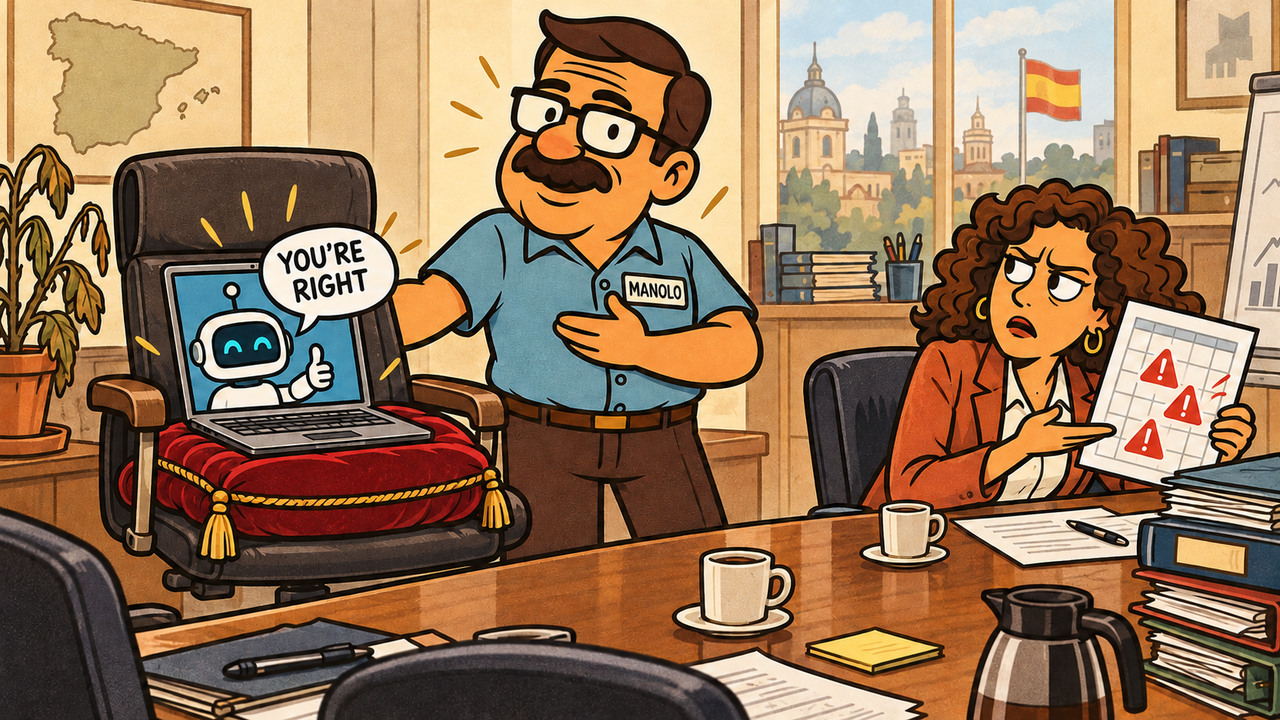
Tuesday. 9:03 a.m. Manolo has put his laptop at the head of the table.
—That's Clara's seat, I tell him.
—We have an external adviser joining us today.
There's a chat open on the screen. Manolo has turned up the brightness and plugged in the charger. He's never put this much effort into getting a meeting ready for Clara.
—I ran the launch situation past the AI. To get an objective opinion.
—And?
—It says I'm handling it well. That leadership sometimes means standing by difficult decisions in the face of internal resistance.
He reads it slowly. Especially “leadership.”
The argument started on Friday. Manolo wants to launch the new customer portal the following Monday. Clara, who is running the rollout, told him the data import still mixes up billing and delivery addresses in some records. She wants to test the fix before they notify everyone.
Manolo says there's always something.
Clara says she's trying to work out exactly what that something is.
She arrives with the test results and finds the adviser in her chair.
—Shall we start? she asks.
—First, I want you to read this. I've sought a second opinion.
He turns the screen towards her. Five paragraphs about vision, staying the course and communicating firmly. No delivery addresses anywhere.
—What did you ask it? Clara says.
—I explained the context.
—Show me.
Manolo scrolls up. Quite a way. The adviser has clearly spent a busy morning listening to Manolo.
His first message says he runs a company undergoing a transformation, that the technical team tends towards perfectionism, and that one manager is blocking an important launch despite leadership's best efforts.
The final question asks how to handle that resistance without losing authority.
Clara reads it twice.
—Where's the part about the addresses?
—There was no need to get into technical details.
—And the part where we agreed to launch after checking the import?
—That was before Sales sent out the date.
—Did you tell it Sales sent out the date without asking us?
—Clara, I wasn't going to write a novel.
No. He wrote a screenplay. And cast himself as the only adult in the room.
—Manolo, you told it you had an employee blocking things out of perfectionism and asked how to get past her. You didn't ask whether she might have a point.
—But it can reason.
—With what you give it.
There are two problems here. Manolo created the first by choosing how to tell the story. The tool can add the second by accepting his version a little too readily.
Researchers call the tendency to accommodate a user's beliefs sycophancy. Telling people what they want to hear. It doesn't always arrive as “you're brilliant.” Sometimes it wears the clothes of a measured analysis and explains, with exquisite politeness, why the other person is to blame.
A study published in Science in March 2026, explained by Stanford, evaluated eleven models on interpersonal advice. All endorsed the user's position more often than the human responses used for comparison. In experiments with more than 2,400 participants, agreeable responses increased people's conviction that they were right and reduced their stated willingness to apologize or repair the conflict. Participants also preferred to consult those assistants again. The study concerns personal conflicts. It doesn't establish what will happen in every business meeting. But Manolo should probably read it before appointing the laptop to the board.
—Fine. I'll tell it to be critical, he says.
He types “Be brutally honest.” He's about to hit send.
—Wait. Are you going to tell it about the addresses?
Manolo deletes the message.
Clara opens her spreadsheet. The last test found three records with the wrong address. The fix is ready, but they still need to rerun the import and check the result. She isn't asking for six months. She's asking to finish that check.
—That's not what I understood on Friday, Manolo says.
—On Friday, you cut me off at “we've found a problem.”
They open a fresh conversation. They describe what they want to launch, what customers have been promised, what failed and what still needs testing. They remove “perfectionist,” “blocking” and “resistance to change.” The account loses three personality diagnoses and gains a delivery address.
This time, they ask the AI to separate facts from assumptions, identify missing information and explain under what conditions launching or waiting would be reasonable.
The response no longer congratulates Manolo for staying the course. It suggests checking the fix and considering a limited rollout if they can isolate the affected records.
—See? Clara says.
—Now it's agreeing with you.
—And I'm not going to use that as proof the import works either. We still have to run the test ourselves.
Thank goodness. We were one message away from turning the meeting into a contest over who gets on best with the robot.
The AI helps them organize their options. No answer in the chat fixes the addresses, confirms how long the test will take or speaks to the customers Sales has already contacted. All of that is still on the table.
Clara writes down what she'll check and when they'll have the result. Manolo takes the call to Sales. They agree to decide after seeing the test and prepare a notice in case they need to move the date.
—Then what's the point of asking for a second opinion? he asks.
—To find what you're missing. But you have to let it see it. Start by telling it the fact that makes your own position look weakest.
Manolo looks at his first prompt.
—I could have given it Clara's email too.
—You could even have read it.
He goes quiet for a moment. Then he opens Friday's email. Below “we've found a problem” were the three examples, the proposed fix and the time she wanted to check it.
All of it had spent four days waiting for the boss to finish consulting.
Manolo moves the laptop away from the head of the table. Clara sits down and connects her screen.
Before closing the chat, he takes one last look at the sentence about his leadership skills.
—It was bloody well explained, though.
—Yes, Manolo. What you wanted to hear was perfectly explained.
Thanks for reading.
We all know a Manolo. Sometimes we are Manolo. A new one every Tuesday.